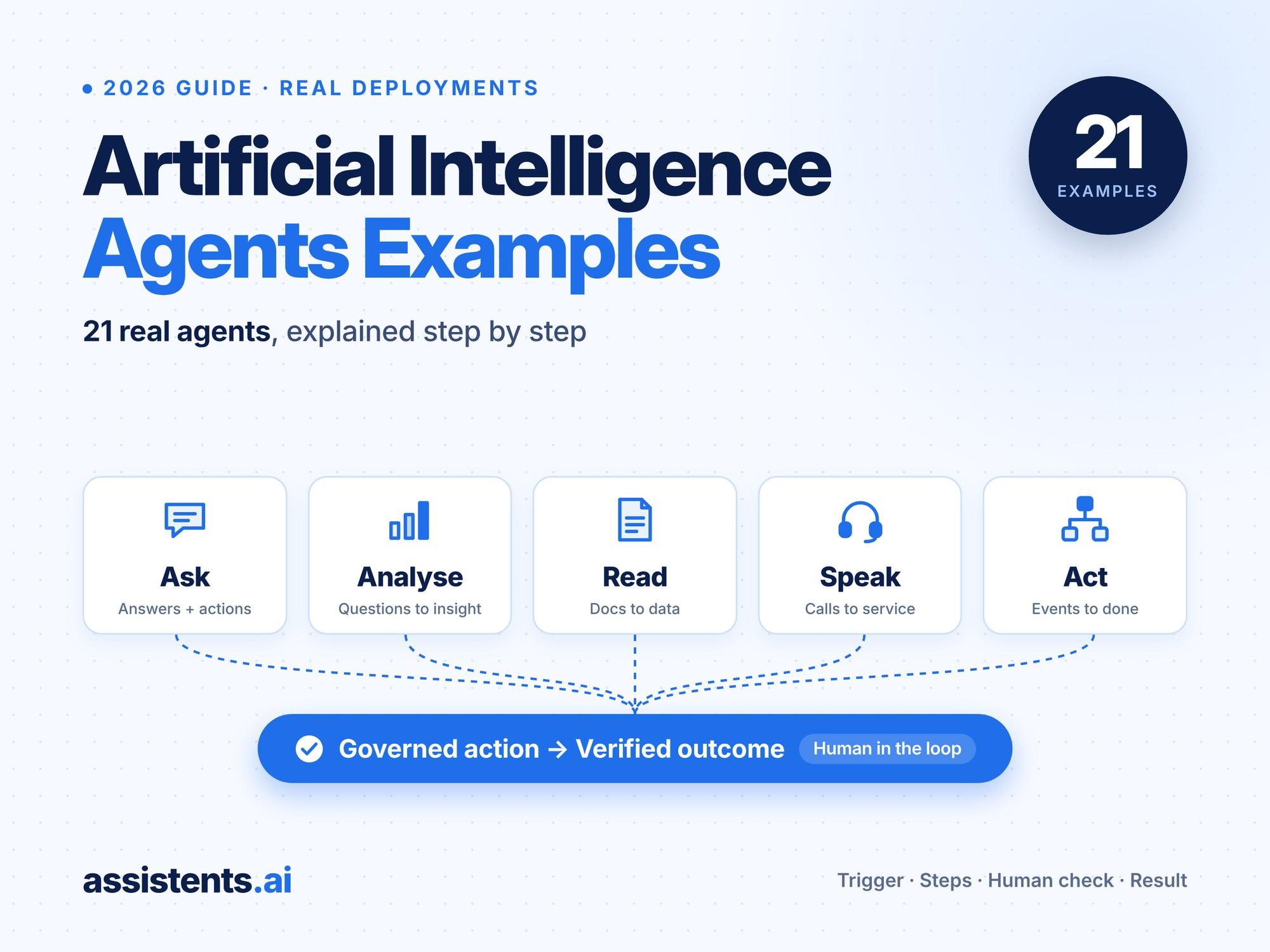
Artificial intelligence agents are software systems that take a goal, use tools and data to plan the steps, and act inside other systems with limited supervision. Well-known examples include OpenAI's ChatGPT agent, GitHub Copilot's coding agent and Klarna's customer service assistant. Less well known are the enterprise agents that turn an emailed purchase order into a validated SAP sales order.
Most lists of AI agent examples stop at a name and a sentence. This guide goes further. It covers 21 artificial intelligence agents examples: 5 famous public agents and 16 agents running in production for enterprises across Africa, Australia, Canada, Europe, India, the Middle East, the UK and the US. Each one is broken down the same way:
- What it does
- Trigger: what starts the work
- Steps: what the agent does, in order
- Human check: where a person stays in control
- Systems: what it connects to
- Result: what it delivered
The examples are grouped by the five things AI agents do in a business: Ask, Analyse, Read, Speak and Act.
Quick answer: The most common examples of AI agents in 2026 are customer support agents (Klarna, Intercom Fin), coding agents (GitHub Copilot), web-task agents (ChatGPT agent), self-driving vehicles (Waymo), and enterprise agents that process documents, monitor data, answer employee questions and run approval-based workflows in ERP and CRM systems.
Artificial intelligence agents examples at a glance
The table below summarises all 21 AI agent examples in this guide. Each row links to the full breakdown further down.
| # | AI agent example | What it does | Trigger | Human check | Result |
|---|---|---|---|---|---|
| 1 | ChatGPT agent | Completes multi-step web and file tasks | User request | Asks permission before consequential actions | Research, bookings and documents done end to end |
| 2 | GitHub Copilot coding agent | Writes code and opens a pull request | Issue assigned to Copilot | Human review before merge and CI | Routine fixes and features delivered as draft PRs |
| 3 | Klarna AI assistant | Resolves customer service chats | Customer message | Handoff to human agents | 2.3M conversations in month one |
| 4 | Waymo Driver | Drives a robotaxi with no one at the wheel | Ride request | Remote assistance on edge cases | Hundreds of thousands of paid rides per week |
| 5 | Intercom Fin | Resolves support across chat, email and voice | Customer query | Handoff with full context | 76% average resolution rate (vendor-reported) |
| 6 | Multilingual store-support agent | Answers store staff in Hindi and English, checks stock, raises tickets | Staff voice or chat query | Ticket escalation to helpdesk | Lower helpdesk load, faster store issue resolution |
| 7 | 24/7 tenant service agent | Triages tenant, rent and payment queries | Web, WhatsApp or email message | Escalation to property team | Lower call-centre load, consistent 24×7 service |
| 8 | Banking disputes and support agent | Routes and summarises cases, suggests next-best action | Chat, email or phone case | Agent-assist; staff decide | Faster, more consistent case handling with audit trails |
| 9 | Competitive price-monitoring agent | Tracks rival prices, offers and ratings, alerts leaders | Continuous schedule | Leaders act on alerts | Always-on monitoring replaced manual portal checks |
| 10 | AI CFO agent | Forecasts cash and flags runway risk | Financial data refresh | Finance team reviews recommendations | Earlier detection of cash risks |
| 11 | Group procurement KPI agent | Alerts on price trends, margin impact and vendor slippage | Scheduled KPI checks | Category owners act | Earlier detection of margin erosion |
| 12 | Industrial sales-signal agent | Spots rising buying activity, creates follow-ups | Rule threshold met | Sales manager follows up | Higher account coverage without added headcount |
| 13 | Tender revision agent | Extracts and compares tender versions, updates job system | New tender document | Human approves changes | Built for up to ~90% faster processing |
| 14 | Purchase-order-to-SAP agent | Turns emailed POs into validated SAP sales orders | PO arrives by email, portal or PDF | Exceptions routed for approval | Less re-entry, fewer data-entry errors |
| 15 | SAP migration-mapping agent | Profiles ECC data, recommends S/4HANA mappings | Migration workstream | Specialist validates every mapping | Reviewable, traceable migration decisions |
| 16 | Cross-border tax-risk agent | Screens transactions for withholding and VAT risk | New deal or transaction | Escalation to tax experts | Earlier risk detection, fewer late deal disruptions |
| 17 | Actor scene-partner voice agent | Reads lines, follows cues, supports self-tapes | Actor starts a scene | Actor controls pacing | More rehearsal without a human reader |
| 18 | Service-appointment voice agent | Reschedules bookings on a live call | Inbound or outbound call | Human handover on request | Booking changed and confirmed in one call |
| 19 | Luxury safari booking agent | Handles booking requests from email to invoice | Guest enquiry email | Human curates the itinerary | Faster booking turnaround at luxury standard |
| 20 | Healthcare staffing agent | Matches nurses to shifts, handles compliance | Facility staffing request | Coordinators approve placements | Faster fill cycles, better utilisation |
| 21 | Grid-exception agent | Detects anomalies, routes field alerts | Sensor and grid data | Field teams resolve | Faster exception response, more proactive operations |
Examples 6 to 21 are anonymised assistents.ai deployments. For more, see our AI agent case studies by industry and AI agent examples by department.
What makes something an AI agent? (A 4-part test)
A system is an AI agent if it passes four tests: it pursues a goal, it uses tools, it acts in another system, and it loops until the work is done or escalated. A chatbot that only answers questions fails the third test. An RPA bot that clicks through a fixed script fails the first, because it has steps, not a goal.
- Goal: It is given an outcome ("create a valid sales order"), not a script.
- Tools: It can call search, databases, APIs, document readers or other agents.
- Action: It changes something in the real world, such as a record, a booking, a ticket or a message.
- Loop: It checks its own result, retries, asks for missing information, or escalates to a human.
AI agent vs chatbot vs AI assistant vs RPA
| Rules chatbot | AI assistant | RPA bot | AI agent | |
|---|---|---|---|---|
| Works from | Scripted answers | Prompts from one user | A fixed click-path | A goal plus business context |
| Handles new situations | No | Yes, in conversation | No, it breaks | Yes, it plans new steps |
| Acts in business systems | Rarely | Limited, user-driven | Yes, but rigidly | Yes, within permissions |
| Handles exceptions | Hands off | User decides | Fails | Routes to the right human, then resumes |
| Example | FAQ widget | Copilot drafting an email | Invoice copy-paste bot | PO-to-SAP order agent |
The 5 classic types of AI agents, in one line each
AI textbooks classify agents by how they decide:
- Simple reflex agent: reacts to the current input with if-then rules. Example: a thermostat.
- Model-based reflex agent: keeps an internal picture of the world. Example: a robot vacuum mapping a room.
- Goal-based agent: plans actions to reach a target. Example: a route planner.
- Utility-based agent: picks the option with the best trade-off. Example: dynamic pricing.
- Learning agent: improves from feedback. Example: a spam filter or a recommendation engine.
Modern enterprise agents built on large language models (LLMs) usually combine several of these. For a deeper breakdown, read our guide to the types of AI agents.
5 famous AI agent examples you already know
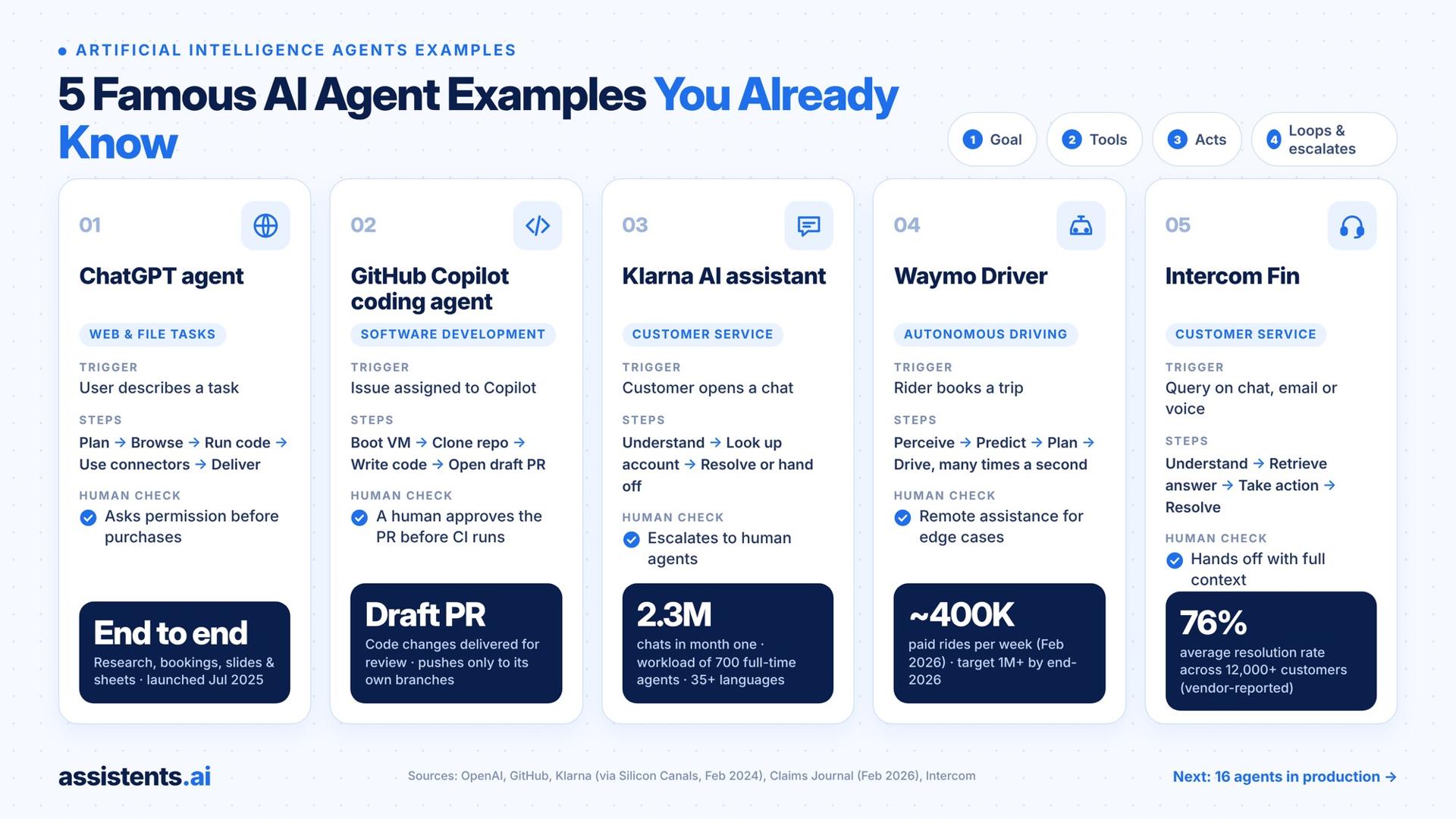
These five public examples show what AI agents look like in consumer and developer products. Each one reflects what the vendor has published.
1. ChatGPT agent (OpenAI)
What it does: ChatGPT agent, launched July 17, 2025, completes multi-step tasks on its own virtual computer. Examples include researching a topic, planning a trip, filling forms, and building slides or spreadsheets.
- Trigger: A user describes the task in ChatGPT.
- Steps: It plans → browses with a visual or text browser → runs code in a terminal → pulls data through connectors such as Gmail or GitHub → delivers the output.
- Human check: It asks for explicit permission before consequential actions such as purchases, and refuses high-risk tasks such as bank transfers. Users can take over the browser at any time.
- Why it's an agent: It has a goal, uses several tools, and acts on websites, not just in chat.
2. GitHub Copilot coding agent
What it does: You assign a GitHub issue to Copilot. The coding agent writes the code and opens a draft pull request.
- Trigger: An issue is assigned to Copilot, or requested from chat or the CLI.
- Steps: It boots a virtual machine on GitHub Actions → clones the repo → analyses the codebase → pushes commits to a draft PR → logs its reasoning.
- Human check: The person who requested the PR can't approve it, and GitHub Actions workflows run only after human approval. The agent can push only to branches it created.
- Why it's an agent: It works in the background toward a goal and changes a real system (your repository).
3. Klarna's AI assistant
What it does: Klarna's OpenAI-powered assistant resolves customer service chats about payments, refunds and disputes.
- Trigger: A customer opens a chat.
- Steps: It understands the request → looks up the customer's account → resolves the issue or hands off.
- Human check: It escalates to human agents when needed.
- Result: In its first month it handled 2.3 million conversations, two-thirds of Klarna's customer service chats. That is the workload of 700 full-time agents, in 35+ languages across 23 markets (source, February 2024).
4. Waymo Driver
What it does: Waymo's autonomous driving system is the classic embodied AI agent. It perceives the road, predicts what others will do, plans a path and controls the vehicle.
- Trigger: A rider books a trip.
- Steps: Perceive (lidar, radar, cameras) → predict → plan → act, many times per second.
- Human check: Remote assistance teams help with unusual situations. No one sits at the wheel.
- Result: About 400,000 paid rides per week across six US cities as of February 2026, with a stated goal of more than 1 million weekly rides by the end of 2026 (source).
5. Intercom Fin
What it does: Fin is an AI customer service agent that works across chat, email, voice, Slack and social channels.
- Trigger: A customer query.
- Steps: It understands the question → retrieves answers from the knowledge base → takes actions through APIs or MCP (updating accounts, processing refunds, troubleshooting) → resolves or hands off.
- Human check: It hands the conversation to the human team with full context.
- Result: Intercom reports a 76% average resolution rate across 12,000+ customers (vendor-reported).
Famous examples are useful for understanding the concept. Most organisations, though, need agents that work inside their own ERP, CRM, documents and approval rules. The next 16 examples show what that looks like in production.
Agents that Ask: conversational AI agent examples
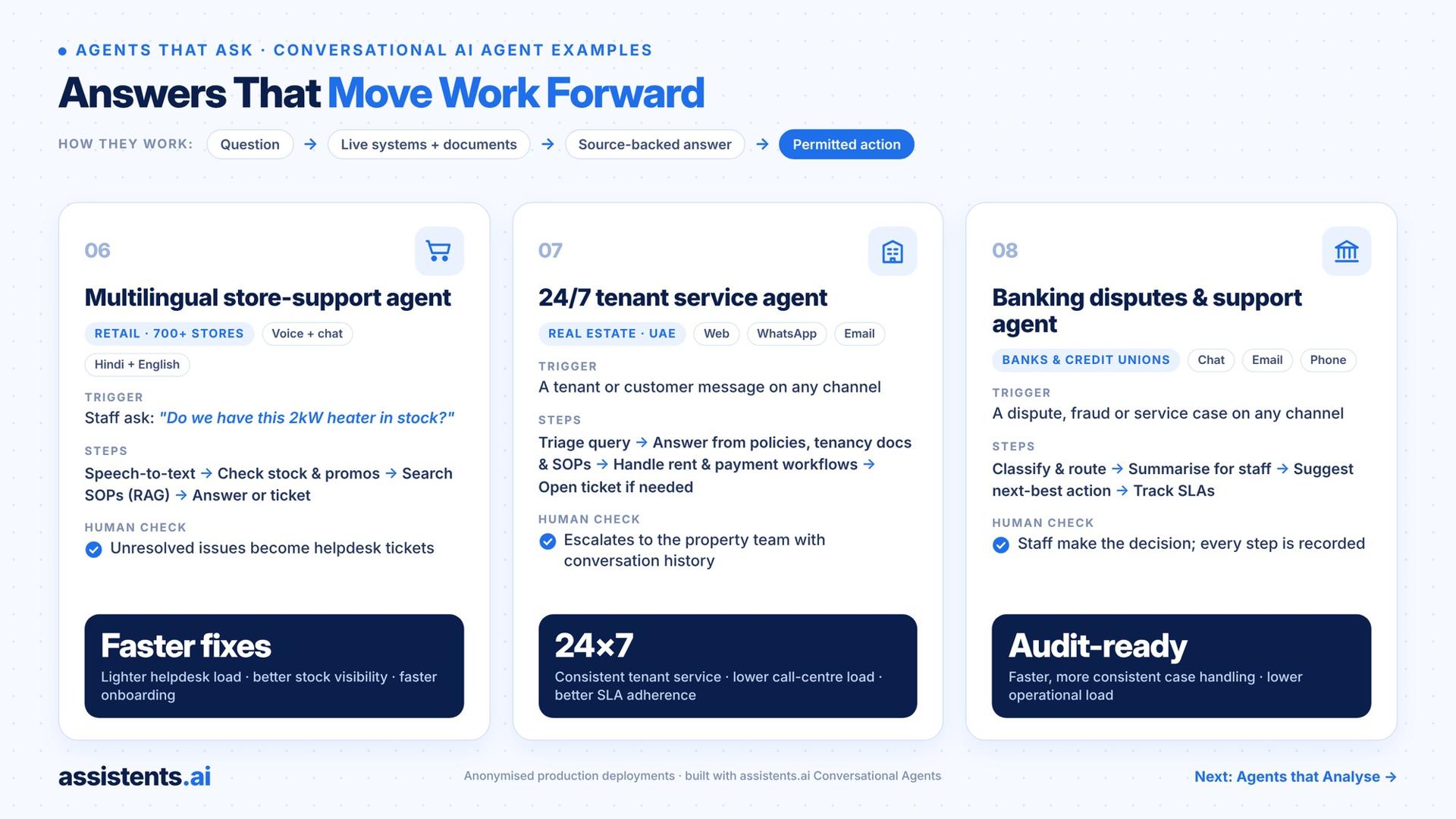
Conversational AI agents give people source-backed answers and can also act on them: create a ticket, update a record or start a workflow. They differ from chatbots because they're connected to live business systems and permitted actions. On assistents.ai they're built with Conversational Agents.
6. Multilingual store-support agent (national value retailer, 700+ stores)
What it does: It gives store staff in a mass-market retail chain instant answers on stock, pricing, promotions and procedures, in Hindi and English, by voice or chat.
- Trigger: A store employee asks a question, such as "Do we have this 2kW heater in stock?"
- Steps: It recognises speech (speech-to-text, then the LLM, then text-to-speech) → checks store-level inventory, pricing and promos → searches POS and SOP documents with retrieval-augmented generation (RAG) → answers or creates a service ticket.
- Human check: Unresolved issues go to the helpdesk as tickets with full context.
- Systems: Inventory, pricing, ticketing, and the POS and SOP knowledge base, plus an admin console with analytics.
- Result: A lighter manual helpdesk burden, faster store issue resolution, better store-level inventory visibility, and faster onboarding through on-demand training.
Related: AI agents for retail and e-commerce.
7. 24/7 tenant service agent (UAE real estate portfolio)
What it does: It automates tenant and customer support for a diversified office, retail, industrial and residential portfolio across several emirates.
- Trigger: A message arrives on the web, WhatsApp or email.
- Steps: It triages the query → answers from a knowledge base of policies, tenancy documents and SOPs → handles rent and payment workflows → opens a ticket if needed.
- Human check: It escalates to the property team with the conversation history.
- Result: Faster responses, lower call-centre load, a consistent 24×7 tenant experience, and better SLA adherence through automatic routing.
Related: AI use cases in real estate.
8. Omnichannel banking disputes and support agent (fintech for banks and credit unions)
What it does: It brings disputes, fraud and service cases from chat, email and phone into one auditable workflow.
- Trigger: A customer case arrives on any channel.
- Steps: It classifies and routes the case → summarises it for the agent → suggests the next-best action → tracks SLAs.
- Human check: Staff make the decision. The agent assists and records every step.
- Result: Faster case handling, more consistent outcomes, lower operational load, and better compliance readiness through audit trails.
Related: AI agent use cases in banking and top AI agents for customer service.
Agents that Analyse: agentic BI examples
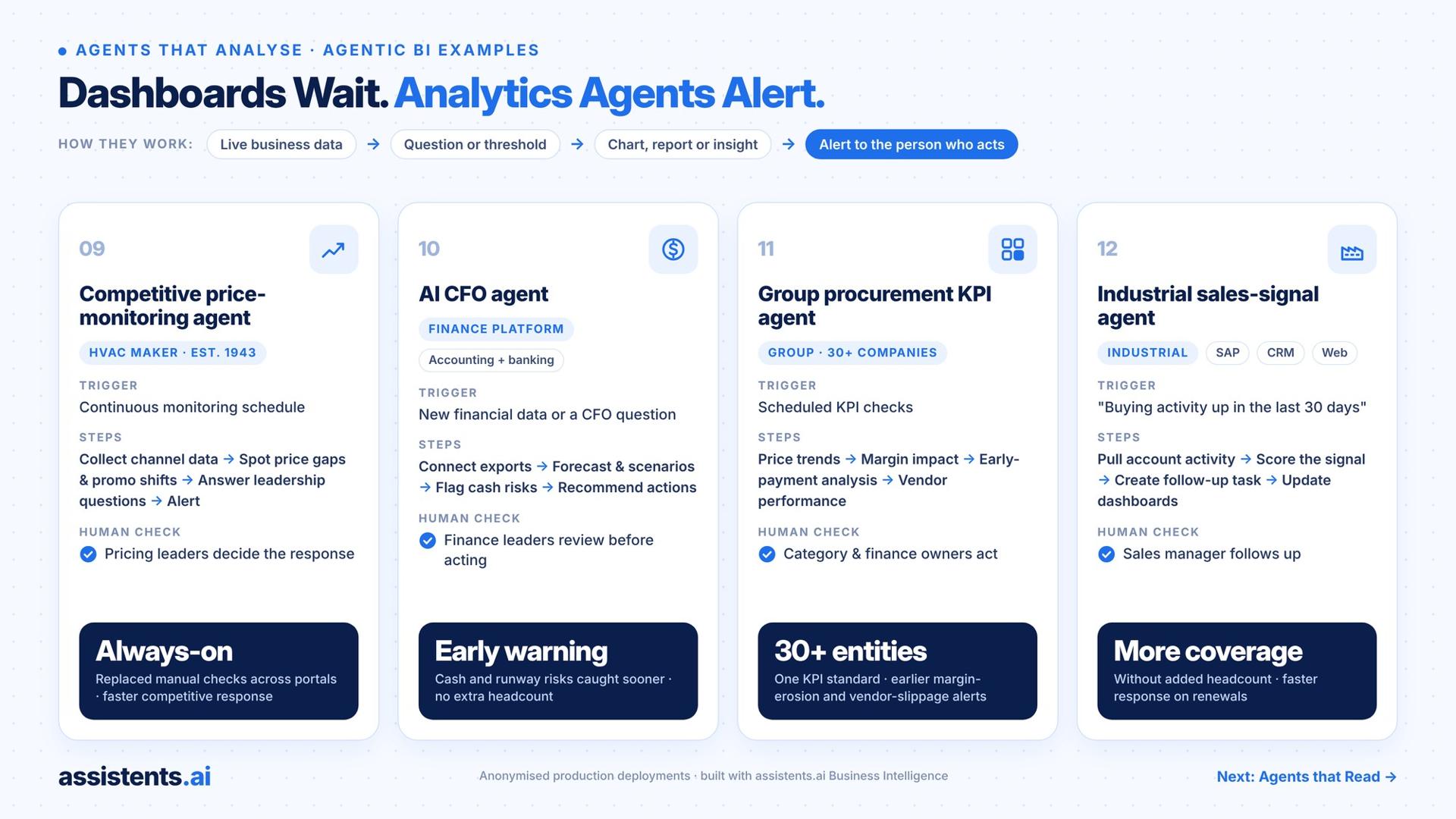
Agentic BI agents turn plain-language business questions into charts, reports and threshold alerts, then route the finding to the person who must act. A dashboard waits to be opened. An analytics agent watches the data and tells you when something needs attention. On assistents.ai this is Business Intelligence. See also agentic BI use cases.
9. Competitive price-monitoring agent (HVAC manufacturer founded in 1943)
What it does: It continuously tracks competitor pricing, MRP and discounts, offers, availability and ratings across e-commerce channels in a highly price-sensitive cooling market.
- Trigger: A continuous monitoring schedule.
- Steps: It collects channel data → spots pricing gaps and promotion shifts → answers leadership questions such as "Where are we being undercut this week?" → sends proactive alerts.
- Human check: Pricing and category leaders decide how to respond.
- Result: Faster competitive response, earlier identification of pricing gaps and promotion shifts, and always-on monitoring that replaced manual checks across portals.
10. AI CFO agent (finance platform for growing businesses)
What it does: It turns accounting and banking data into real-time cashflow monitoring, forecasts and scenario plans.
- Trigger: New financial data, or a question from a CFO or advisor.
- Steps: It connects accounting and banking exports → runs forecast and scenario agents → flags runway and cash risks → recommends actions. Advisors get a portfolio view across clients.
- Human check: Finance leaders review the recommendations before acting.
- Result: Faster analysis cycles, earlier detection of cash risks and anomalies, and advisor-level insight without extra headcount.
Related: AI solutions for CFOs.
11. Group procurement and finance KPI agent (family conglomerate, 30+ companies)
What it does: It standardises procurement and finance KPIs across group entities and raises automatic alerts.
- Trigger: Scheduled KPI checks.
- Steps: It monitors purchase-price trends → calculates gross-margin impact → analyses early-payment options (notional finance cost) → tracks vendor delivery and returns → sends insight packs to leadership.
- Human check: Category and finance owners act on the alerts.
- Result: Earlier detection of margin erosion and vendor slippage, standardised intelligence across entities, and fewer variance surprises.
Related: agentic AI use cases in procurement.
12. Industrial sales-signal agent
What it does: It joins SAP, CRM, order, service, web and email data into one customer view, and flags accounts showing buying intent.
- Trigger: A rule is met, for example "buying activity increased in the last 30 days".
- Steps: It pulls account activity (a quotation request in SAP, a closed service case, website visits) → scores the signal → creates a follow-up task → updates sales dashboards.
- Human check: The sales manager follows up and prepares for the meeting.
- Result: Higher account coverage without more headcount, faster response on opportunities and renewals, and more consistent execution through governed playbooks.
Related: AI agent use cases for sales.
Agents that Read: document AI agent examples
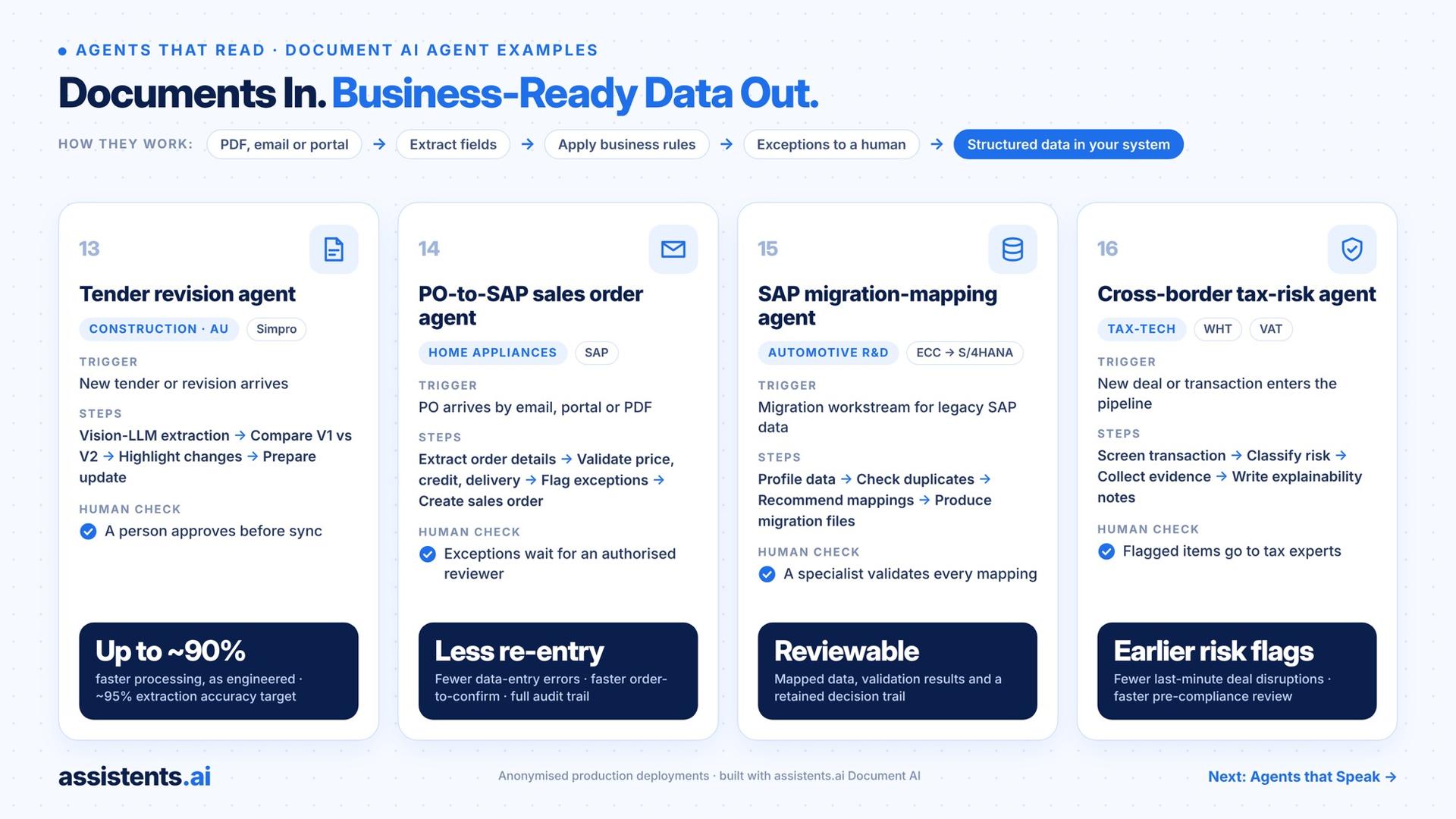
Document AI agents read layouts and tables, extract fields, apply business rules, and send structured data into your systems. Anything that fails a rule goes to human review. This is one of the highest-return categories of AI agent, because so much enterprise work still starts with a PDF. On assistents.ai it is Document AI. See also AI agents for document processing.
13. Tender revision agent (Australian commercial remediation specialist)
What it does: It ingests complex tender documents, detects what changed between versions, and keeps the job-management system in sync.
- Trigger: A new tender or tender revision arrives.
- Steps: Vision-LLM extraction from complex PDFs → workflow determination → revision analysis. For example, it spots that V2 added a lighting upgrade and raised the value from $480,000 to $510,000 → it prepares the update.
- Human check: A person reviews the highlighted changes before the system is updated. Quotes are locked and audit logs kept.
- Systems: A multi-agent document workbench with full read and write integration into Simpro.
- Result: Engineered for up to ~90% faster tender document processing, with a ~95% extraction accuracy target for standard formats. Revision detection and auditability also reduce bid risk.
Related: AI agent use cases in construction.
14. Purchase-order-to-SAP sales order agent (premium home-appliance distributor)
What it does: It reads incoming purchase orders and creates validated sales orders in SAP. It replaced a legacy OCR tool that was reaching end-of-life with high licensing costs.
- Trigger: A PO arrives by email, portal or PDF.
- Steps: It extracts customer, products, quantities, pricing and delivery details → validates them against customer, product, pricing, credit and delivery data → flags exceptions such as missing information, duplicate orders or items outside policy → creates the sales order in SAP.
- Human check: Exceptions wait for an authorised reviewer, then the order resumes.
- Result: Less manual re-entry, a faster order-to-confirmation cycle with fewer data-entry errors, clearer exceptions, and a traceable audit trail for every order.
Related: sales order automation AI.
15. SAP ECC to S/4HANA migration-mapping agent (a leading German premium automotive brand)
What it does: It supports migration decisions in automotive R&D by profiling legacy SAP data and recommending mappings.
- Trigger: A migration workstream covering customer data, material master, vendor records, transactions and custom tables.
- Steps: It discovers and profiles the data → checks for duplicates and inconsistencies → recommends mappings and transformation rules → produces migration files.
- Human check: A specialist reviews and validates every suggested mapping.
- Result: Reviewable migration decisions, with mapped data, validation results and a retained decision trail.
16. Cross-border tax-risk screening agent (tax-tech platform)
What it does: It screens cross-border transactions early for withholding tax, VAT mismatches and permanent-establishment risk.
- Trigger: A new deal or transaction enters the pipeline.
- Steps: It runs screening workflows → classifies the risk → collects evidence → writes explainability notes.
- Human check: Flagged items go to tax experts.
- Result: Earlier detection of withholding and VAT risk, fewer last-minute deal disruptions, and faster, more consistent pre-compliance review.
Related: AI agents for regulatory compliance.
Agents that Speak: voice AI agent examples
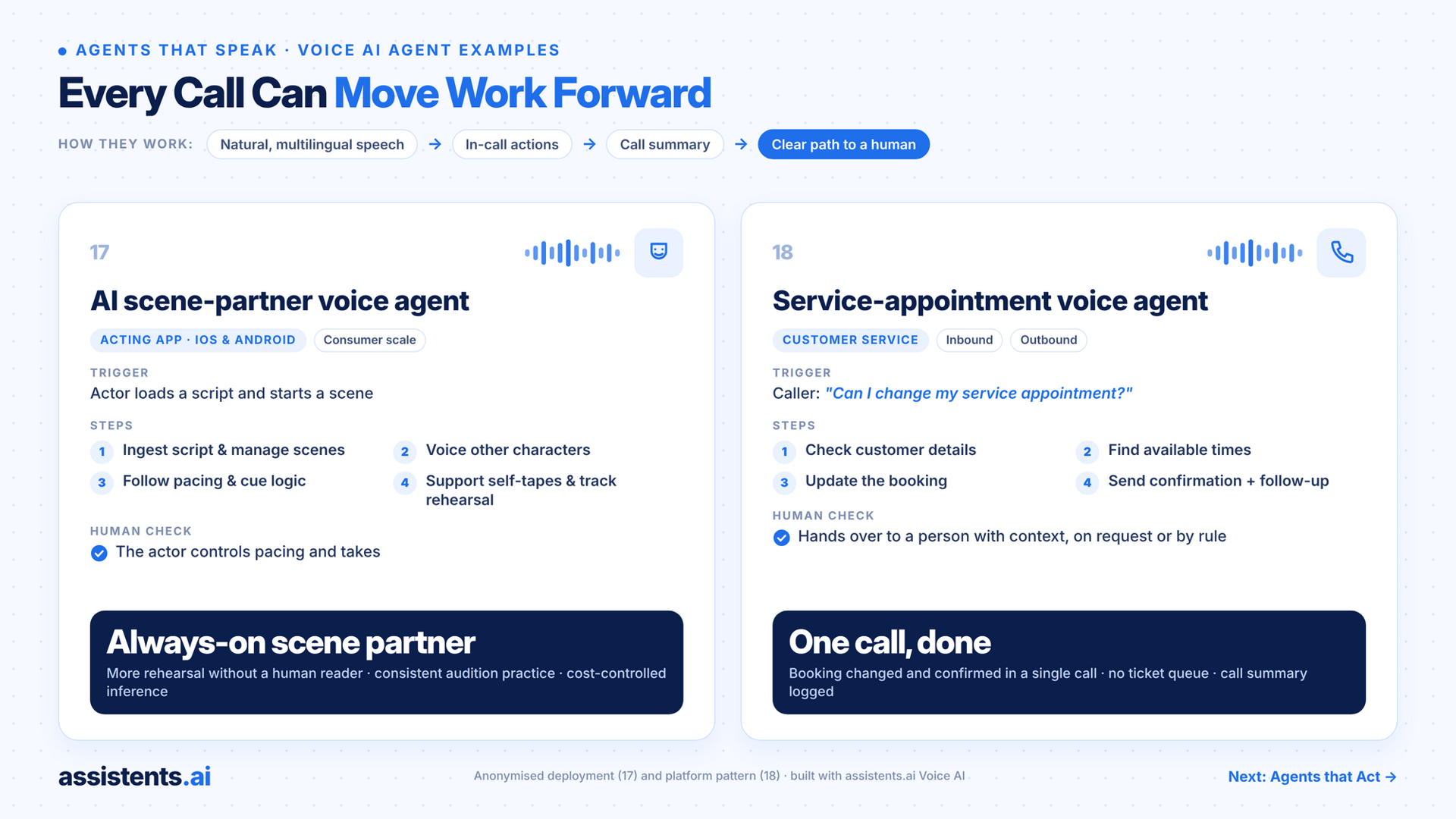
Voice AI agents hold natural, multilingual conversations and take actions during the call. They check records, update bookings and create follow-ups, with a clear path to a human. On assistents.ai this is Voice AI. Compare providers in AI voice agent services for businesses.
17. AI scene-partner voice agent (acting app on iOS and Android)
What it does: It acts as an always-available scene partner, so actors can rehearse, run lines and record self-tapes without a human reader.
- Trigger: The actor loads a script and starts a scene.
- Steps: It ingests the script and manages scenes → voices the other characters with character and voice control → follows pacing and cue logic → supports the self-tape workflow and tracks rehearsal analytics.
- Human check: The actor controls pacing and takes.
- Systems: Cost-controlled inference keeps unit economics viable at consumer scale.
- Result: More rehearsal without human readers, more consistent audition practice, and better readiness.
18. Service-appointment voice agent
What it does: It handles inbound and outbound calls such as "Can I change my service appointment?" from start to finish.
- Trigger: A customer calls.
- Steps: It checks customer details → finds available times → updates the booking → sends a confirmation → creates a follow-up task and a call summary.
- Human check: It hands over to a person with context, whenever the caller asks or a rule requires it.
- Result: The booking is changed and confirmed in a single call, with no ticket queue.
Agents that Act: autonomous AI agent examples
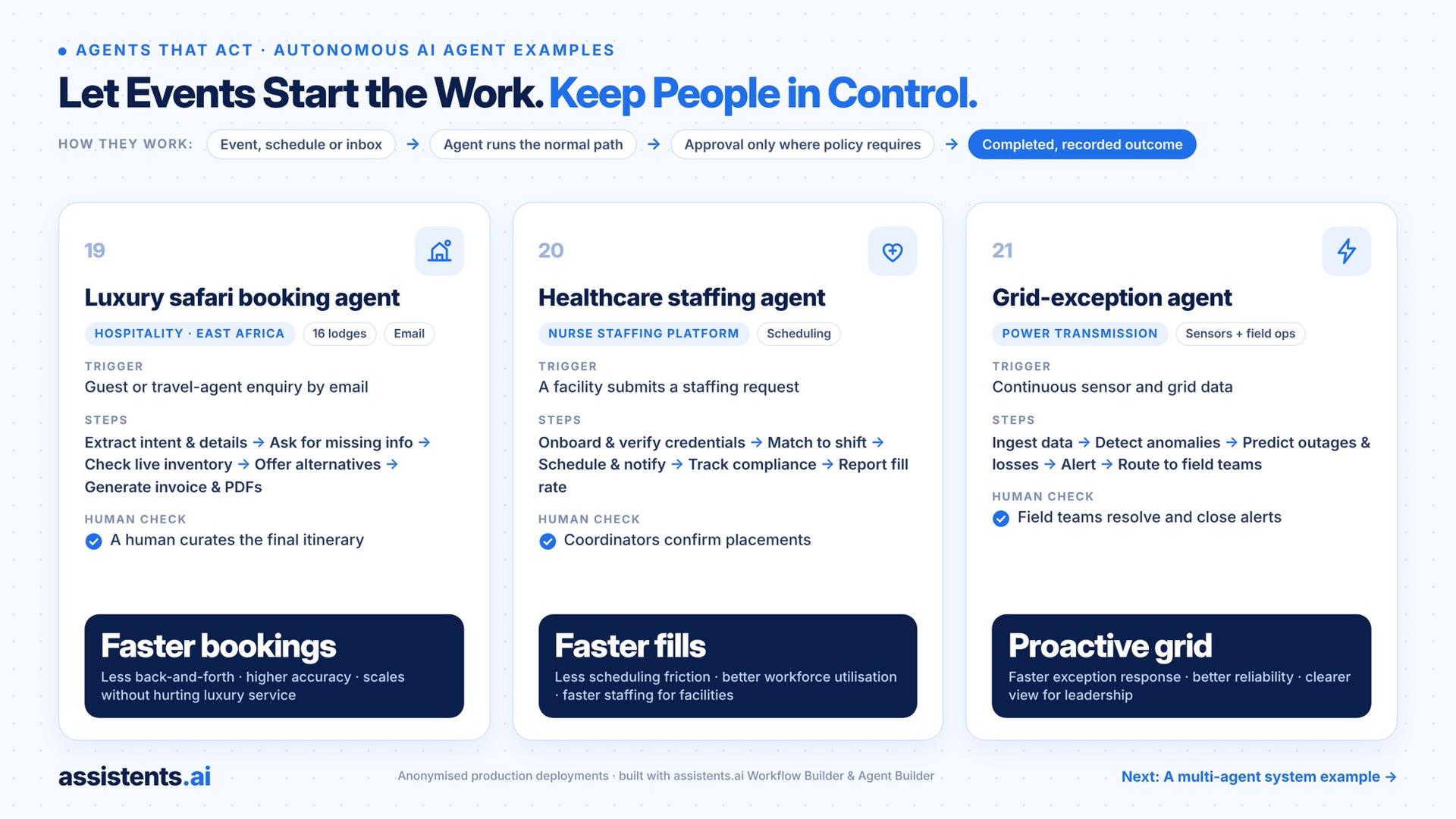
Autonomous AI agents start work from events, schedules and inboxes, and complete it across systems. Approvals are applied only where policy requires them. This is what most people mean by "agentic AI examples": the agent runs the normal path, and people handle the exceptions. On assistents.ai these are built with the Workflow Builder and Agent Builder.
19. Luxury safari booking agent (16 lodges and camps in Kenya and Tanzania)
What it does: A digital booking agent runs luxury travel booking end to end, without lowering the standard of service guests expect.
- Trigger: A guest or travel-agent enquiry arrives by email.
- Steps: It classifies intent and extracts the details → asks for any missing information in a conversation → checks inventory in real time → proposes alternative dates or properties if needed → generates the invoice and PDF documents.
- Human check: A human curates the final itinerary (a hybrid handoff).
- Result: Faster booking turnaround with less back-and-forth, higher accuracy on complex guest requirements, and operations that scale without hurting luxury service.
Related: agentic AI in hospitality.
20. Healthcare staffing agent (nurse staffing platform)
What it does: It runs the matching, scheduling and compliance work that connects nursing professionals with facility shifts.
- Trigger: A facility submits a staffing request.
- Steps: It onboards talent and captures credentials → applies matching logic → schedules and notifies → tracks compliance → reports fill rate and utilisation.
- Human check: Coordinators confirm placements and handle exceptions.
- Result: Faster fill cycles, less scheduling friction, better workforce utilisation, and faster staffing for facilities.
Related: HIPAA-compliant AI chatbots.
21. Grid-exception agent (state power transmission utility)
What it does: It monitors transmission KPIs and turns anomalies into routed field actions.
- Trigger: Continuous sensor and grid data.
- Steps: It ingests the data → detects anomalies → predicts outages, losses and field issues → sends automated alerts → routes the work to field teams.
- Human check: Field operations teams resolve and close the alerts.
- Result: Faster detection of exceptions and risks, better reliability through proactive monitoring, and clearer operational transparency for leadership.
Related: AI use cases in operations.
A multi-agent system example: from emailed PO to SAP sales order
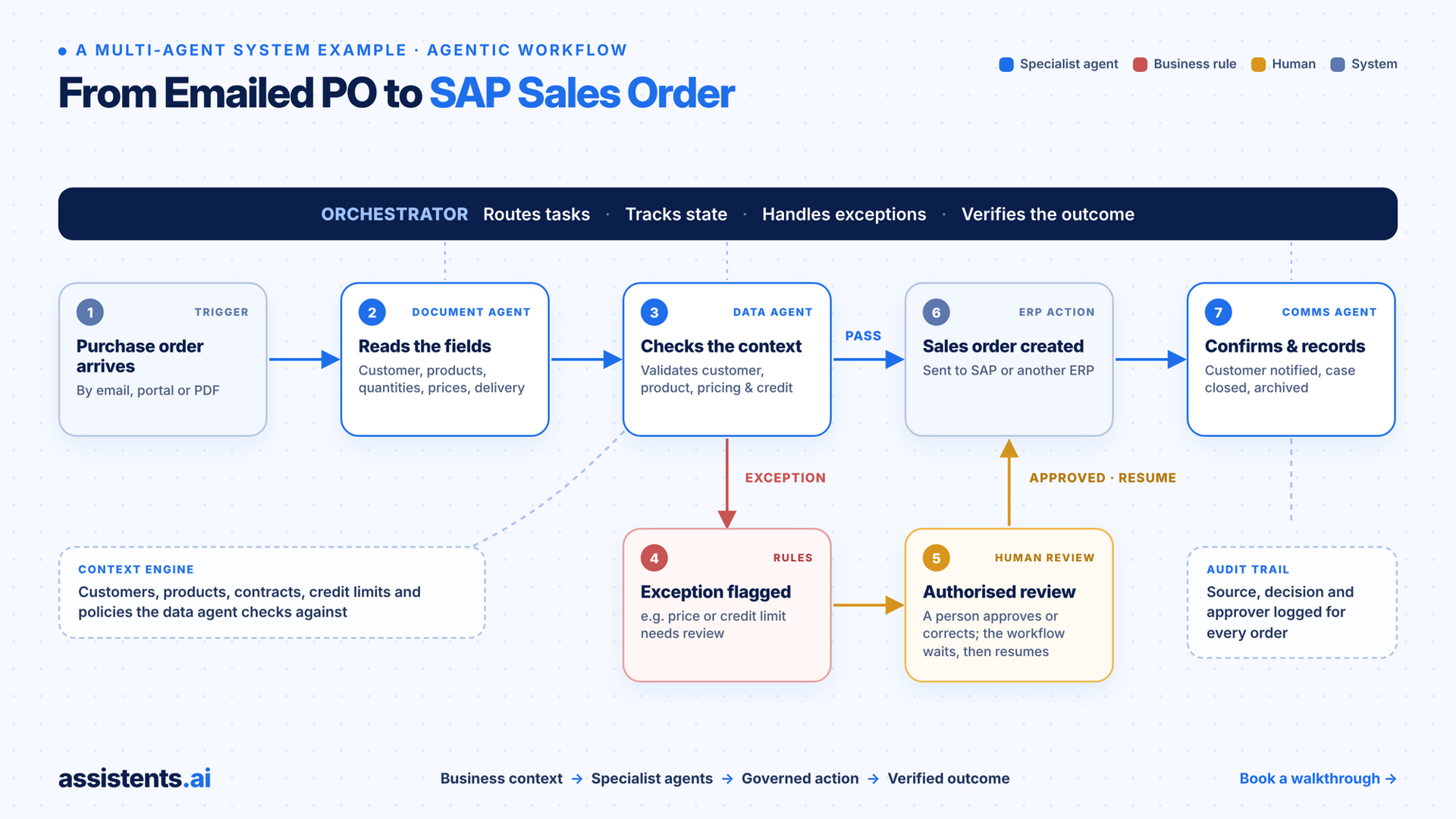
A multi-agent system splits one business process across specialist agents, coordinated by an orchestrator that tracks state, handles exceptions and verifies the outcome. Here is how three specialist agents work together on the purchase-order example (#14), taken from the assistents.ai platform design:
- Incoming purchase order: it arrives by email or portal.
- Document agent reads the fields: it extracts customer, products, quantities, prices and delivery details.
- Data agent checks the context: it validates the customer and products against business data in the Context Engine.
- Rules flag an exception: for example, the price or credit limit requires review.
- Authorised review: a person approves or corrects the order, and the workflow waits, then resumes.
- Sales order created: the order is sent to SAP or another ERP.
- Communication agent confirms: the customer is notified, the case is closed, and the record is archived for audit.
PO arrives by email
  -> Document agent extracts fields
  -> Data agent validates customer, product and credit
     -> Pass: create sales order in SAP
     -> Exception: human review, then create sales order in SAP
  -> Communication agent confirms and records outcome
This is an agentic workflow example: no single agent does everything. The orchestrator routes tasks, keeps track of state, handles exceptions and verifies outcomes. That's why multi-agent designs hold up in production better than one large "do everything" agent. For frameworks, see our agentic AI frameworks comparison.
Every example in this guide shares one pattern: business context, then specialist agents, then a governed action, then a verified outcome. That pattern is the assistents.ai platform. Conversational agents, agentic BI, document AI, voice AI and autonomous workflows run on one foundation, with permissions, approvals and audit built in. Book a walkthrough →
Is ChatGPT an AI agent? Is Siri? The boundary test
ChatGPT in normal chat mode is an AI assistant. ChatGPT agent is an AI agent. Siri and Alexa are voice assistants with limited agent behaviour. The difference is whether the system pursues a goal across tools and acts in other systems. Here is how common tools score on the 4-part test:
| System | Goal | Tools | Acts in other systems | Loops and escalates | Verdict |
|---|---|---|---|---|---|
| ChatGPT (chat mode) | Per prompt | Some (search, code) | Rarely | No | AI assistant |
| ChatGPT agent | Yes | Browser, terminal, connectors | Yes, with permission | Yes | AI agent |
| Siri / Alexa | Per command | Device and app actions | Simple ones (timers, smart home) | Minimal | Assistant with light agent features |
| RPA bot | No, a fixed script | UI clicks | Yes, rigidly | No, it fails on change | Automation, not an agent |
| Rules-based FAQ chatbot | No | None | No | No | Chatbot |
| PO-to-SAP order agent (#14) | Yes | Document AI, ERP, rules | Yes, within policy | Yes, with human review | AI agent |
Gartner warns about "agent washing": rebranding chatbots, RPA or assistants as agents. It estimates that only about 130 of the thousands of vendors claiming agentic AI are genuine (Gartner, June 2025). Use the 4-part test above to check any vendor's claims.
What the best AI agent examples have in common
The AI agent examples that reach production share five traits: one clearly defined process, real business context, role-based permissions, a human exception path, and a measured baseline. The stakes are high. Gartner predicts that over 40% of agentic AI projects will be canceled by the end of 2027 because of rising costs, unclear business value or inadequate risk controls. It also predicts that by 2028, 15% of day-to-day work decisions will be made autonomously and 33% of enterprise software applications will include agentic AI (Gartner).
- One process, not a platform tour. Every example above automates a single process: PO to sales order, tender revision, or tenant query to resolution.
- Business context. Agents need entities, relationships, definitions and policies, not just documents. The agent in #14 knows which contract, credit limit and discount rules apply to each order.
- Permissions by role. Each action passes an access check and a policy check. It is then allowed, sent for human approval or blocked and logged.
- A human exception path. None of these agents is fully autonomous on the hard cases. Missing product references, tender value changes and new itineraries all go to a person.
- A measured baseline. Measure order-processing time, support resolution time, review effort and exception visibility before go-live, track the change, then keep improving.
For what these deployments cost, see how much it costs to build an AI agent.
How to choose your first AI agent (6 steps)
Start with one valuable, high-volume process that has clear rules, a known exception path and a measurable baseline. Then expand. This is the delivery approach behind every assistents.ai example above:
- Select a valuable opportunity: high volume, rule-based, painful today. Success measure: the current cycle time and error rate, written down.
- Connect the systems the process touches, such as ERP (including SAP), CRM, inboxes and document stores. Success measure: read and write access confirmed in a test environment.
- Configure the agents and the workflow: instructions, knowledge, tools, permissions and approval thresholds. Success measure: the agent completes test cases end to end.
- Validate on real cases and refine, with a human in the loop from day one. Success measure: accuracy and exception rate meet the agreed threshold.
- Operate and support. Monitor execution, exceptions and audit logs. Success measure: the cycle-time improvement holds for 30 days.
- Expand to the next use case on the same foundation, reusing integrations, context and controls. Success measure: the second use case goes live faster than the first.
Looking for ideas? Browse 65+ AI agent use cases or enterprise-level AI use cases.
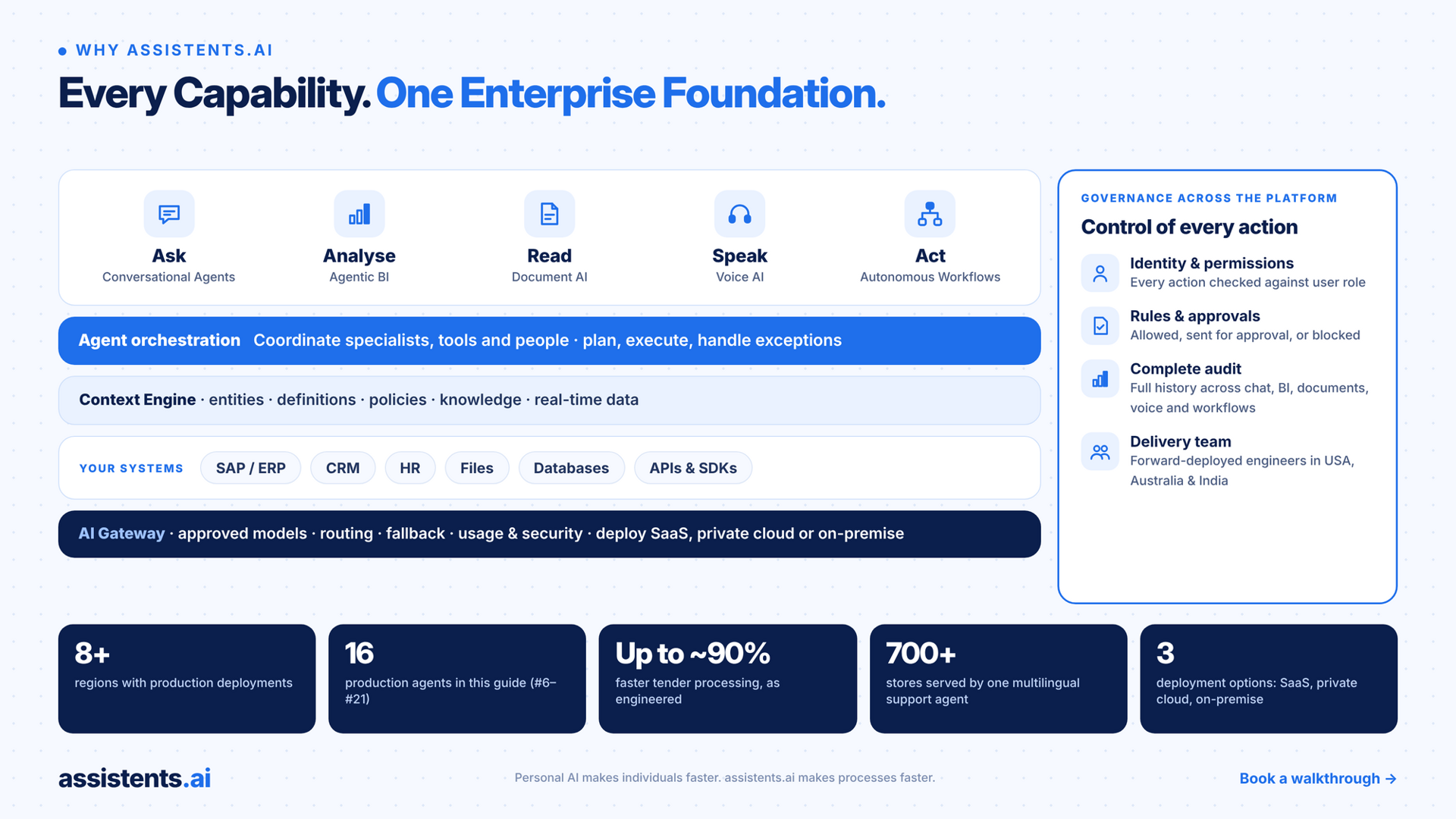
Why assistents.ai is the top platform for building AI agents like these
Copilot, Claude and ChatGPT make individuals faster: they draft, summarise, research and analyse. The examples in this guide make processes faster. assistents.ai is built for that second job, organisational productivity. It takes a business event and turns it into a verified outcome inside your ERP, CRM and documents.
One platform for all five things agents do
Ask (Conversational Agents), Analyse (Agentic BI), Read (Document AI), Speak (Voice AI) and Act (Autonomous Workflows). Use one capability, or combine them to transform a whole process. Deep Research, Canvas, Agent Builder and Workflow Builder let your teams build and extend agents themselves.
Context that makes agents understand your business
The Context Engine connects entities, relationships, business definitions, policies and source evidence. So an agent knows that order SO-10432 belongs to a retail customer under contract MSA-204, with a credit limit that triggers review. The agent works from your rules, not a generic model's guess.
Governance by architecture, not by policy document
With Agent Governance, every action passes an access check (user role and permissions) and a policy evaluation (rules and constraints). It is then allowed, sent for human approval, or blocked and logged. You get permissions, business rules, human approvals and a complete audit history across chat, analytics, documents, voice and workflows.
Built on the systems you already use
Connect SAP and other ERPs, CRM, HR, files and databases through secure APIs, SDKs and connectors, with event ingestion and two-way sync. The AI Gateway lets you choose approved models, with task routing, fallback, high availability and usage management. Deploy as cloud SaaS, in a private cloud or on-premise.
Proven in production across 8+ regions
Examples 6 to 21 in this guide run on assistents.ai. They include PO-to-SAP order creation, SAP S/4HANA migration support for a leading German premium automotive brand, tender processing built for up to ~90% faster turnaround, and multilingual frontline support at 700+ store scale. Deployments span retail, logistics, banking, energy, healthcare, hospitality, construction and real estate, across Africa, Australia, Canada, Europe, India, the UAE, the UK and the US.
A team that delivers, not just a licence
Forward-deployed engineers, AI engineers, and data science and machine learning experts work from the USA, Australia and India. They cover the whole journey, from configuration to enterprise delivery. You bring one priority process; we map its systems, handoffs and approval points, and agree with you how success will be measured.
Personal AI assistants vs assistents.ai
| Personal AI assistants (Copilot, ChatGPT, Claude) | assistents.ai | |
|---|---|---|
| Built for | Helping one person complete a task | Running a shared business process end to end |
| Works in | Chat, documents, email | ERP (incl. SAP), CRM, HR, databases, voice, inboxes |
| Acts on systems | Limited, user-driven | Event-triggered, governed actions |
| Human control | The user reviews the output | Role permissions, approval thresholds, audit trail |
| Measured by | Time saved per user | Cycle time, throughput, exception rate, control |
| Deployment | Vendor cloud | SaaS, private cloud or on-premise |
These vendors also offer enterprise and agent capabilities. This is a use-case comparison. Comparing platforms? Read assistents.ai vs Salesforce Agentforce and assistents.ai vs CrewAI.
Start with the process that matters most. Book a tailored platform walkthrough →
Conclusion: the best artificial intelligence agents examples finish the work
The artificial intelligence agents examples that matter in 2026 aren't the ones with the flashiest demos. They are the ones that take a real business event, such as a purchase order, a tender revision, a tenant message or a grid anomaly, and carry it through to a verified, auditable outcome, with people in control of the exceptions. Start with one process, measure it, and build from there.
Bring one priority process. Book a tailored platform walkthrough with assistents.ai →
Continue reading
- AI agent examples by department
- AI agent case studies by industry
- Types of AI agents, explained
- 65+ AI agent use cases transforming enterprises
- AI agent platform for enterprise
FAQs
What are examples of AI agents?
Common examples of AI agents include ChatGPT agent (web and file tasks), GitHub Copilot's coding agent (writes code and opens pull requests), Klarna's and Intercom's customer service agents, and Waymo's self-driving system. In enterprises, examples include agents that turn emailed purchase orders into SAP sales orders, compare tender revisions, monitor competitor prices, and answer store staff in several languages.
Is ChatGPT an AI agent?
Standard ChatGPT is an AI assistant: it responds to prompts in a conversation. ChatGPT agent, launched in July 2025, is an AI agent. It plans multi-step tasks, uses a browser, a terminal and connectors, and acts on websites, asking permission before consequential actions such as purchases.
Is Siri or Alexa an AI agent?
Siri and Alexa are voice assistants with light agent features. They can take simple actions such as setting timers, controlling smart-home devices or sending messages. They don't usually pursue multi-step goals across business systems, check their own results or escalate exceptions, which are the traits that define a full AI agent.
What are the 5 types of AI agents?
The five classic types are simple reflex agents, model-based reflex agents, goal-based agents, utility-based agents and learning agents. Modern enterprise agents built on large language models often combine several of these and work together in multi-agent systems. See our full guide to the types of AI agents.
What is the difference between an AI agent and a chatbot?
A chatbot answers questions, usually from scripts or a knowledge base. An AI agent pursues a goal: it uses tools, takes actions in business systems (creating an order, updating a booking, raising a ticket), checks the result and escalates exceptions to a human. A chatbot talks; an agent completes work.
What is an example of an agentic workflow?
A purchase order arriving by email is a good example. A document agent extracts the fields, a data agent validates the customer, pricing and credit, business rules flag any exception for human approval, the sales order is created in SAP, and a communication agent confirms with the customer. Several specialist agents complete one process together.
How do AI agents work?
AI agents work in a loop: perceive, reason, act, check. They take input (a message, a document or an event), use a large language model plus business context to plan the steps, call tools and systems to act, then check the result. If a rule or confidence threshold isn't met, they escalate to a human.
Which companies use AI agents?
Klarna, Intercom, GitHub, OpenAI and Waymo run well-known AI agents. Across industries, retailers, logistics companies, banks, utilities, real estate groups, healthcare providers and manufacturers use AI agents for support, document processing, analytics, voice service and workflow automation. The 16 production examples above span all of these sectors.
Are AI agents safe to use with company data?
They can be, if governance is built into the architecture. Look for role-based permissions inherited from your systems, policy checks before every action, human approval thresholds, full audit logs, approved-model routing, and deployment options such as private cloud or on-premise. Avoid agents that act with broad, unmonitored access.
What are the risks of autonomous AI agents?
The main risks are wrong actions taken at scale, hallucinated data entering systems, excessive permissions, unclear accountability and rising costs. Gartner predicts over 40% of agentic AI projects will be canceled by 2027 because of cost, unclear value or weak risk controls. Narrow scope, human exception paths and audit trails reduce these risks.
How long does it take to deploy an AI agent?
A focused first use case, such as order processing or frontline support, typically moves from scoping to validated production in weeks to a few months. Timing depends on system integrations, data quality and approval design. Later use cases go faster because they reuse the same integrations, context and controls.
How do I choose my first AI agent use case?
Choose a high-volume, rule-based process that is painful today and has a clear exception path, such as purchase-order entry, tender review or internal support queries. Record a baseline, keep a human in the loop at the start, prove the improvement, then expand to the next process on the same platform.