The use of AI in consulting takes two forms. Inside the firm, AI speeds up research, proposals, slide production, knowledge retrieval and engagement management. In client work, consultants now deliver AI itself: governed analytics, document operations and AI agents that run parts of a client's process under human control. In 2026 the shift is from AI as an assistant that drafts things to AI as a governed digital worker that owns bounded work — and that is changing what a consulting deliverable is.
This guide walks through 35 use cases across both sides, with public examples from the largest firms and anonymised results from engagements our team has delivered across India, the Middle East, Europe, Australia and North America.
Key takeaways
- AI in consulting is no longer one thing: firm-internal productivity, client analytics, specialist advisory work and client-delivered agentic operations are four distinct use-case families with different economics.
- Task-level productivity is real (McKinsey reports its consultants save up to 30% of their time with its internal assistant), but enterprise-level financial impact is still rare — which is where consulting firms that deliver operated outcomes rather than decks will win.
- Most firms are at the "assist" and "co-work" stages internally. The commercial opportunity is in delegated and exception-managed AI delivered to clients.
- Governance — rules, approvals, audit trails, data control — is the difference between a pilot and a service line.
- The right first step is one bounded, measurable use case, not a firm-wide transformation programme.
What "use of AI in consulting" means in 2026
Definition: The use of AI in consulting is the application of machine learning, large language models and AI agents to the work consulting firms do — both the internal work of running engagements and the external work of delivering analysis, recommendations and operational change to clients. It spans everything from an assistant that summarises a data room to a governed agent that runs a client's receivables follow-up.
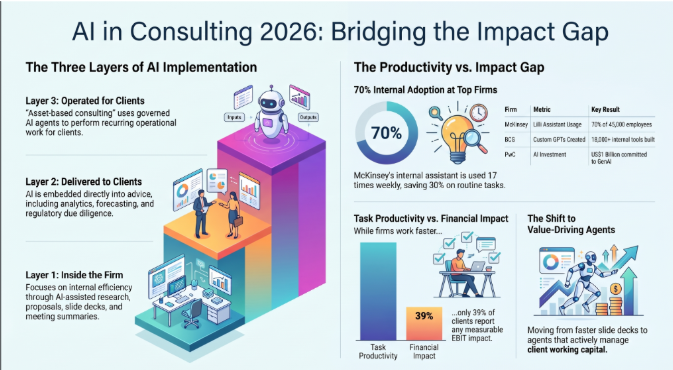
There are three layers, and firms tend to conflate them:
- Inside the firm. Research, knowledge, proposals, decks, meetings, staffing. This is where nearly every firm started, and where the public examples come from.
- Delivered to clients. Analytics, forecasting, document intelligence, due diligence, tax and regulatory work — AI embedded in the advice itself.
- Operated for clients. AI agents that perform recurring work inside the client's process under agreed rules and approvals. IBM calls the broader trend asset-based consulting: firms packaging reusable tools and models instead of reselling the same manual effort on every engagement.
The adoption numbers show how far the first layer has travelled. McKinsey's internal assistant, Lilli, is used by more than 70% of the firm's roughly 45,000 employees, around 17 times a week, and the firm reports time savings of up to 30% on routine tasks. BCG rolled ChatGPT Enterprise out to its entire workforce, whose staff have since built more than 18,000 custom GPTs; roughly 40% of associates use its slide tool, Deckster, every week. PwC committed US$1 billion to generative AI and became one of OpenAI's largest enterprise customers.
Set that against what clients are actually realising. McKinsey's State of AI 2025 survey found only around 39% of organisations attribute any EBIT impact to AI, and most of those put it below 5% of EBIT. The gap between task productivity and enterprise financial impact is the defining fact of AI in consulting right now — and it is the gap the third layer exists to close. A faster deck does not move a client's working capital. A governed agent that chases overdue invoices every day does.
The consulting AI autonomy ladder
Autonomy is not a switch. It is a progression of operating modes, and the mode determines what controls you need. The table below adapts an enterprise autonomy ladder to consulting work.
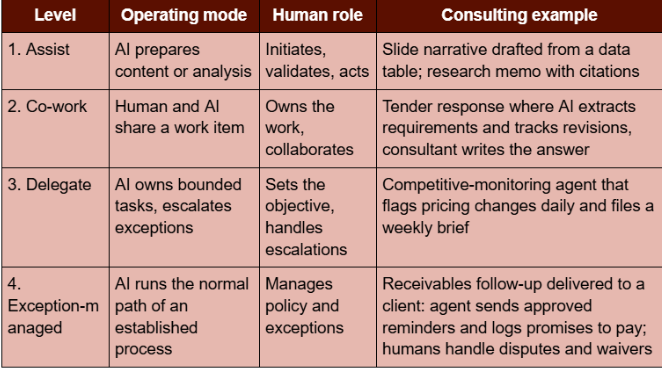
The principle that makes levels 3 and 4 safe is deterministic macro, agentic micro. A durable workflow owns the process: stages, approvals, deadlines, retries, rollback. The AI agent chooses adaptive steps only inside a bounded zone — gathering evidence, forming hypotheses, selecting tools, asking for clarification. It cannot widen its own authority or change the surrounding process.
Most consulting firms sit at levels 1 and 2 internally, and that is appropriate. The commercial opportunity is levels 3 and 4 delivered to clients, because that is where the value moves from hours saved to outcomes owned.
Use of AI inside the consulting firm: 10 use cases
Each use case below lists what it does, who uses it, the autonomy level it typically runs at, the evidence, and the watch-out that trips firms up.
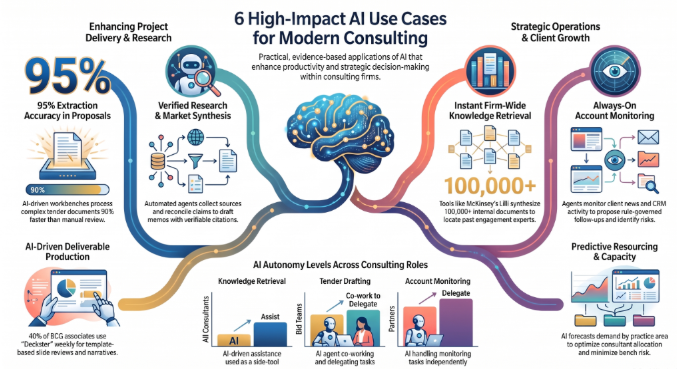
1. Firm knowledge retrieval and expert location. An assistant grounded in the firm's own documents, frameworks and past engagements answers "have we done this before?" and finds the person who did it. Who: every consultant, especially those joining a new engagement. Autonomy: Assist. Evidence: McKinsey's Lilli synthesises more than 100,000 internal documents and is the canonical example. Watch-out: permission-aware retrieval is non-negotiable — a knowledge assistant that surfaces one client's material to a team serving its competitor is a conflict incident, not a productivity win.
2. Research and market synthesis with citations. Agents collect sources, extract claims, reconcile conflicts and draft a memo with verifiable references. Who: analysts and associates in the first two weeks of an engagement. Autonomy: Assist to Co-work. Evidence: In an engagement for a specialised tax-research product our team built automated source collection, summarisation and draft-memo generation with citations; the observed effects were faster research cycles and less manual source-hunting. Watch-out: uncited synthesis is worthless in advisory work. Insist on citation-backed output and treat any uncited number as unverified.
3. Proposal, RFP and tender response drafting with revision tracking. Vision-capable models extract requirements from complex PDFs, determine the workflow, detect revisions between tender versions and push structured data into the firm's operational systems. Who: bid teams, practice leads. Autonomy: Co-work to Delegate. Evidence: For a remedial-construction specialist in Australia our team delivered a multi-agent document workbench with tender retrieval, revision analysis and deep integration into its job-management system, with quote locking and audit logs. It was engineered for up to ~90% faster tender-document processing and a ~95% extraction-accuracy target on standard formats. Watch-out: state targets as targets. Extraction accuracy on non-standard formats is lower, which is why human review stays in the loop.
4. Slide and deliverable production with quality review. AI produces slide narratives from findings — one headline, three supported points, one "so what" — and reviews drafts against house standards. Who: associates and managers. Autonomy: Assist. Evidence: BCG's Deckster, trained on hundreds of internal templates, is used weekly by around 40% of associates; its "review this" feature is its most popular. Watch-out: the output is only as good as the underlying analysis. Use it to remove formatting time, not to invent findings.
5. Meeting intelligence and engagement notes. Transcripts become decisions, actions, owners and commitments, filed against the engagement. Who: engagement managers. Autonomy: Assist. Evidence: the fastest-adopted category in the market, because the value is immediate. Watch-out: client consent for recording, and where the transcript is stored, are contractual questions. Answer them before the first call.
6. Data-room intake and document extraction. Contracts, financials, policies and correspondence are ingested, classified and extracted into structured evidence with a review queue. Who: diligence, restructuring and transformation teams. Autonomy: Co-work. Evidence: the same document-intelligence pattern used in tender intake (use case 3) and lending operations (use case 31). Watch-out: extraction without validation rules produces confident errors at scale. Pair extraction with deterministic checks.
7. Staffing, utilisation and capacity analytics. Forecast demand by practice, surface bench risk, optimise allocation. Who: resourcing and practice operations. Autonomy: Assist to Delegate. Evidence: our team has delivered utilisation and slot-optimisation analytics for a multi-branch training business in the UAE and matching-and-scheduling workflows for a US staffing platform — the same mechanics apply to a consulting bench. Watch-out: utilisation dashboards nobody acts on are the norm; wire the analytics to a weekly decision.
8. Scoping, pricing and benchmark retrieval. Retrieve comparable past engagements, effort actuals and outcome data to price and scope new work. Who: partners and bid leads. Autonomy: Assist. Evidence: a direct extension of use case 1 over engagement metadata. Watch-out: only works if effort actuals are captured consistently. Fix time-capture discipline first.
9. Account monitoring and next-best actions. An always-on agent watches client signals — news, filings, hiring, spend patterns, CRM activity — and proposes rule-governed follow-ups and renewal risks. Who: client-service partners and business development. Autonomy: Delegate. Evidence: For an engineering and technology group in the UAE our team delivered an agentic sales agent with continuous account monitoring, rule-governed opportunity identification and CRM-integration-ready follow-up orchestration, aimed at higher account coverage without added headcount. Watch-out: the rules that decide what counts as an opportunity must be written by the people who own the accounts, not the vendor.
10. Internal policy, compliance and learning agents. Answer independence, conflict, expense and methodology questions from firm policy; generate personalised onboarding paths. Who: everyone; risk and HR own it. Autonomy: Assist. Evidence: the retrieval pattern of use case 1 over policy documents. Watch-out: policy answers need version control — an agent citing last year's independence rules is a liability.
AI in client analytics and diagnostics: 8 use cases
11. Conversational analytics over governed client data. Business users ask questions in natural language and receive certified answers, with the SQL and lineage visible. Who: data and analytics practices delivering self-serve analytics. Autonomy: Assist. Evidence: Our team has delivered natural-language analytics agents for a Silicon Valley analytics start-up and a UAE e-commerce and appliance retailer, with a semantic governance layer for consistent definitions. Reported effects: shorter analysis cycles for recurring questions and reduced reporting dependency on analysts. Watch-out: text-to-SQL without a semantic layer gives four different answers to "what is revenue?" Certify metrics first.
12. Multi-entity KPI consolidation and metric standardisation. Standardise KPI definitions across entities and countries, consolidate reporting, and explain variances automatically. Who: finance-transformation and PMI teams. Autonomy: Assist to Delegate. Evidence: For a global logistics and warehousing company our team consolidated analytics across multi-entity operations with cross-entity KPI standardisation, data-quality checks and a governance layer — producing a single operational view and faster leadership reporting. Watch-out: the hard part is political, not technical: agreeing whose definition of "on-time" wins.
13. Variance explanation and automated insight narratives. The system does not just show a variance; it decomposes it into drivers and writes the explanation. Who: performance-improvement and finance advisory. Autonomy: Assist. Evidence: For a physician-led clinical enterprise in the US our team built a revenue and utilisation analytics model with performance dashboards, variance explanations and action lists for billing workflow. Watch-out: a generated narrative is a hypothesis. Show the evidence beside it.
14. Competitive and pricing intelligence monitoring. Agents continuously monitor competitor pricing, discounts, availability and ratings across e-commerce and channel portals, map findings to leadership questions, and alert on threats. Who: strategy and pricing practices. Autonomy: Delegate. Evidence: For a large Indian HVAC manufacturer our team delivered a full implementation of competitive-monitoring agents with agentic Q&A mapped to leadership questions, pricing-gap views and an architecture that scaled from proof of concept to production with governance and audit trails. Effect: always-on monitoring replaced manual portal checks and shortened competitive response cycles. Watch-out: scraping terms and rate limits are a legal and engineering question; design for them.
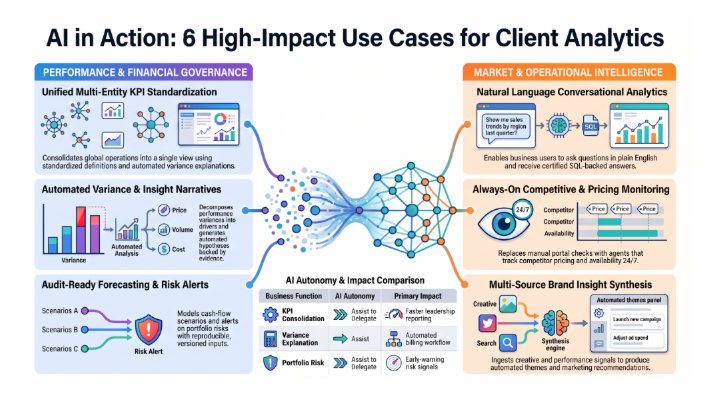
15. Forecasting, cash-flow and scenario modelling. Forecast and scenario agents connect to accounting and banking exports, model runway and alert on cash risk with recommended actions. Who: CFO advisory, fractional-CFO practices, turnaround teams. Autonomy: Assist to Delegate. Evidence: Our team built an AI CFO agent for a finance-software provider — continuous cash-flow insight, forecast and scenario agents, and portfolio views for advisors managing multiple clients. Watch-out: forecasts must be versioned and reproducible; an agent that cannot show which inputs produced last month's number is not audit-ready.
16. Portfolio risk analytics. Risk, delinquency, maturity and residual-value KPIs with exception alerts and early risk signals. Who: financial-services advisory. Autonomy: Assist to Delegate. Evidence: For an independent automotive-leasing provider in Canada our team delivered portfolio and dealer-network analytics with alerts for exceptions — better portfolio visibility and faster risk identification. Watch-out: early-warning thresholds drift; review them quarterly.
17. Funnel and customer-experience analytics. Enrolment-to-completion funnels, resource utilisation and CX dashboards with alerts. Who: operations and CX consultants. Autonomy: Assist. Evidence: the UAE training-institute engagement in use case 7. Watch-out: funnel analytics tell you where people drop; they do not tell you why. Pair with qualitative work.
18. Brand and marketing insight synthesis. Multi-source ingestion of creative, performance and audience signals; insight agents produce themes, narratives and recommendations. Who: marketing and brand consultancies. Autonomy: Assist. Evidence: Our team delivered an insight-synthesis platform for a US brand-insights studio and campaign-operations automation for an Australian creator-economy platform, including content-KPI monitoring and brand-safety checks. Watch-out: brand-safety checks need explicit rules, not model judgement alone.
AI in specialist advisory practices: 9 use cases
19. Technical due diligence. Code and architecture review, infrastructure and security assessment, scalability and integration readiness, a risk register and a remediation roadmap — accelerated by AI reading the codebase and documentation. Who: M&A advisory, PE operating partners. Autonomy: Co-work. Evidence: For a long-term holding company our team performed technical due diligence on a mobile-banking target, producing a structured risk register and remediation plan that supported a faster investment decision and reduced post-deal surprises. Watch-out: AI finds patterns; the diligence opinion is a human's. Keep the signature human.
20. Tax research automation with citations. Automated source retrieval, summarisation and draft position memos with citations, tracked in a growing knowledge base. Who: tax advisory. Autonomy: Assist to Co-work. Evidence: the sales-and-use-tax research engagement in use case 2. Watch-out: jurisdictional currency — sources must carry effective dates.
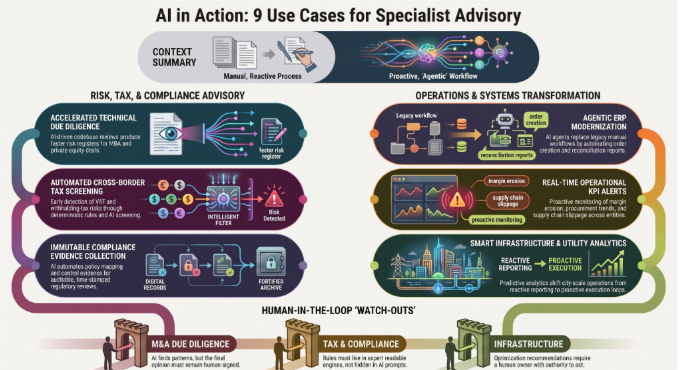
21. Cross-border tax risk pre-screening. Transactions are screened early for withholding-tax, VAT-mismatch and permanent-establishment risk, with evidence collection, explainability notes and escalation to tax experts. Who: international tax and deal-advisory teams. Autonomy: Delegate. Evidence: Our team built screening workflows and risk classification for a UK tax-tech product — earlier detection of withholding and VAT risk and fewer last-minute deal disruptions. Watch-out: classification rules belong in a deterministic rules engine that experts can read and version, not in a prompt.
22. Regulatory and compliance evidence. Continuous collection of control evidence, policy mapping and explainability notes for audit and regulatory review. Who: risk and compliance advisory. Autonomy: Delegate. Evidence: the evidence-collection and audit-trail patterns in use cases 21 and 29. Watch-out: evidence must be immutable and time-stamped; a mutable audit trail is not one.
23. Finance transformation: procurement and finance KPI alerts across group entities. Group-wide KPI standardisation plus automated alerts on purchase-price trends, gross-margin impact, early-payment economics and vendor delivery and returns performance. Who: finance and procurement transformation. Autonomy: Delegate. Evidence: For a diversified family-business group in the UAE our team delivered automated procurement and finance KPI alerts across entities with scheduled insight packs for leadership — earlier detection of margin erosion and vendor slippage. Watch-out: alert fatigue. Severity and de-duplication rules are part of the design.
24. ERP and legacy modernisation: agentic order automation. Agents interpret order triggers, validate them against rules, create sales orders in the ERP and produce reconciliation reports — replacing an end-of-life document-capture workflow with high licensing cost. Who: technology and ERP consulting. Autonomy: Exception-managed, with maker-checker on ERP writes. Evidence: For a UAE appliance distributor our team delivered automated SAP sales-order creation with rules for exceptions and approvals, audit logs and reconciliation reporting, as an integration-ready replacement for a legacy content-capture product. Effects: reduced manual order processing and legacy dependency, faster order-to-confirm cycles. Watch-out: ERP connectivity is an integration project through published APIs, not a connector to switch on. Scope it honestly.
25. Supply-chain and logistics operations. Digitise terminal workflows, add rail scheduling visibility and exception management, and give executives operational alerts. Who: operations and supply-chain consulting. Autonomy: Assist to Delegate. Evidence: Our team delivered a terminal-and-rail management solution for a global ports and logistics operator to digitise port-to-inland operations, targeting higher predictability of terminal-to-rail throughput. Watch-out: operational data quality at the edge is the constraint; budget for it.
26. Energy and sustainability advisory. Utility and sensor data ingestion, anomaly detection, forecasting and optimisation recommendations with proactive alerting. Who: sustainability and facilities consulting. Autonomy: Delegate. Evidence: For a research campus in India our team delivered energy-consumption monitoring, forecasting and optimisation with dashboards and alerts — improved energy visibility and faster detection of inefficiencies. Watch-out: optimisation recommendations need a human owner with authority to act on them.
27. Utilities and public-sector infrastructure. Smart-grid ingestion, predictive analytics for outages and losses, automated alerting and workflow routing; at city scale, an agentic layer that turns dashboard insights into governed, auditable tasks. Who: public-sector and infrastructure advisory. Autonomy: Delegate. Evidence: Our team delivered transmission KPI monitoring and anomaly detection for a state power utility in India, and a unified context engine, semantic governance layer and insights-to-action agents for a smart-city operations unit — shifting reporting from reactive to proactive execution loops. Watch-out: public-sector procurement will ask for on-premises deployment and data residency. Have the answer.
Client-delivered agentic operations: 8 use cases
This is where consulting is heading, and where the deliverable changes. For decades the end product was a report; then it became a dashboard. The next deliverable is an operated outcome: a governed human–agent team that owns one business operation and its metric.
We call that unit an Agentic Workcell. It packages a business objective, the work intake, the digital roles and human roles, the context they share, the capabilities they may invoke, the policies and approvals that bound them, and the outcome metric that proves value. The customer does not buy an agent. It buys the reliable performance of a business operation — and the consulting firm that designs, deploys and tunes the Workcell moves from time-billed advice to a recurring, outcome-linked relationship.
28. Insights-to-action layer over existing dashboards. Existing BI is left in place; an agentic layer converts insights into governed tasks with owners, deadlines and completion tracking. Who: analytics and operations consultancies. Autonomy: Delegate. Evidence: For a privately held retail holding company in India our team delivered a unified context engine over structured and unstructured data, a semantic governance layer and an active orchestrator integrating with core systems — automated task creation and completion tracking, and standardised decision logic across teams. Watch-out: the ontology must include the client's "verbs" (actions and approvals), not just its data nouns.
29. Omnichannel service operations with audit trails. Chat, email and voice intake, workflow routing, agent-assist summarisation, next-best actions, SLA monitoring and full auditability. Who: customer-operations transformation. Autonomy: Exception-managed. Evidence: Our team delivered omnichannel banking-support agents with auditable workflow automation for a global banking-automation provider, and an end-to-end tenant-service agent for a UAE real-estate portfolio owner — faster case handling, lower call-centre load and better compliance readiness through audit trails. Watch-out: regulated service contexts need approval gates on anything that changes an account.
30. Receivables follow-up Workcell. An agent prioritises overdue accounts, sends approved reminders, logs contact outcomes, records promises to pay and creates follow-up work; humans handle disputes, negotiations and any credit or waiver. Who: finance-transformation and shared-services consultancies. Autonomy: Exception-managed by segment and value. Evidence: overdue-payment follow-up is one of the production patterns our platform has run. The outcome contract measures cash collected, promise-to-pay kept rate, DSO movement, dispute resolution time and complaint rate. Watch-out: autonomy expands by customer segment and balance threshold, never by one global switch.
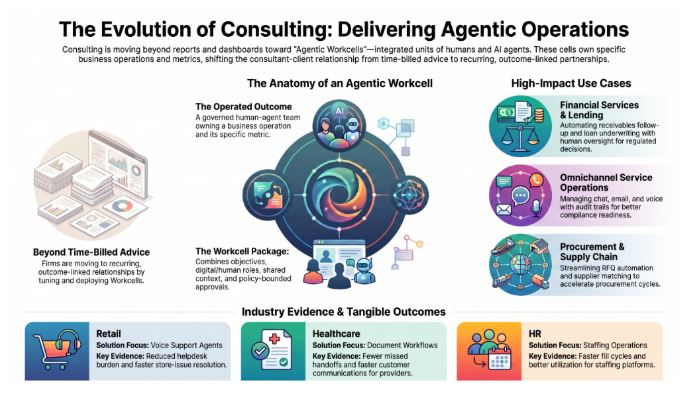
31. Lending operations case management. Document verification, KYC, bureau and income analysis, policy explanation and underwriting memos prepared by agents; binding credit policy in a versioned rules engine; humans hold authority for regulated decisions, deviations, sanction and disbursement. Who: financial-services consulting and lending transformation. Autonomy: Co-work to Delegate. Evidence: a lending operating-system pattern our team has specified and built on, combining case management, document AI, deterministic policy and human review. Watch-out: a loan application is a case with durable state; chat sessions are not a system of record.
32. Procurement RFQ automation and supplier discovery. RFQ preparation and follow-up, supplier matching, quotation extraction and comparison, and analytics on price, lead time and vendor performance. Who: procurement transformation. Autonomy: Delegate, with delegation-of-authority limits and maker-checker on ERP writes. Evidence: For a pharma-sourcing platform in India our team delivered RFQ automation and supplier-matching workflows with quality and regulatory document handling — faster procurement cycles and less manual vendor follow-up. Watch-out: segregation of duties must be enforced by the workflow, not by convention.
33. Voice agents for store support and field sales. Bilingual voice support (Hindi and English) for store staff, an inventory-intelligence agent answering pricing, stock and promotion questions per store, and a knowledge agent trained on POS and SOP documents. Who: retail and field-operations consultancies. Autonomy: Delegate. Evidence: Our team delivered these agents for a national value retailer in India with an admin console, analytics and ticketing integration — reduced helpdesk burden, faster store-issue resolution and faster onboarding. Voice-based field-sales assistance is another production pattern we have run. Watch-out: telephony, latency and language coverage are engineering constraints to test early.
34. Document-heavy service workflows. Booking, processing, status monitoring, customer notification and reporting orchestrated end to end. Who: healthcare and consumer-services consulting. Autonomy: Exception-managed. Evidence: Our team automated testing-service workflows for a UK private-healthcare provider — fewer missed handoffs, faster customer communications and unified reporting. Watch-out: health data brings jurisdiction-specific obligations; deployment location matters.
35. Workforce and staffing operations. Talent onboarding and credential capture, staffing-request intake, matching, scheduling, compliance workflows and fill-rate reporting. Who: HR and workforce consultancies. Autonomy: Delegate. Evidence: the US healthcare-staffing platform in use case 7 — faster fill cycles and better utilisation. Watch-out: credential expiry rules must be deterministic and auditable.
AI tools for consulting: categories compared
There is no single "AI tool for consultants". Each category below has a legitimate role, and most firms will run three or four of them. The question is which one carries the client-facing work.
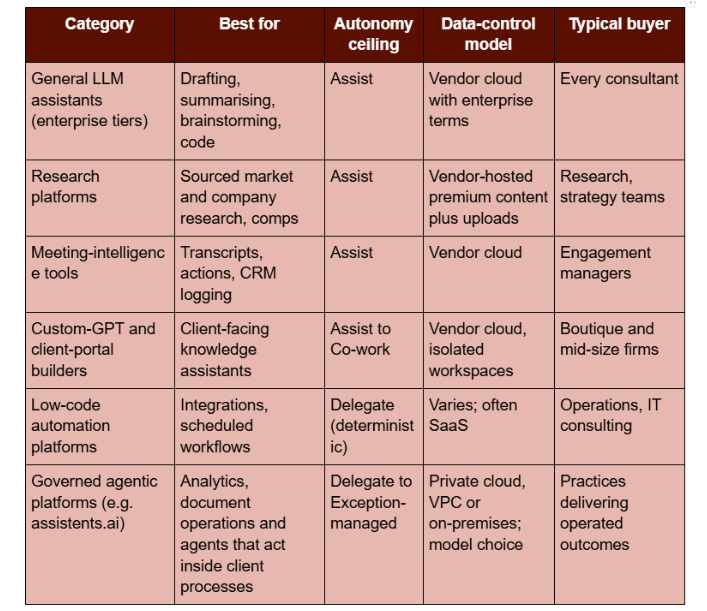
Where assistents.ai fits. The platform belongs in the last row because it is built for the delivered-to-client side of the ladder. It combines natural-language analytics over governed data, semantic metrics with row-level security, document ingestion and review, an agent builder with multi-agent orchestration, a workflow engine with human tasks and approvals, a deterministic rules engine for policy, voice agents, audit trails and model routing across multiple providers — deployable in private cloud, the client's VPC or on-premises. That combination is what lets a consulting practice deliver a use case at level 3 or 4 with controls a client's risk function will accept.
Risks and governance: what a partner's risk committee will ask
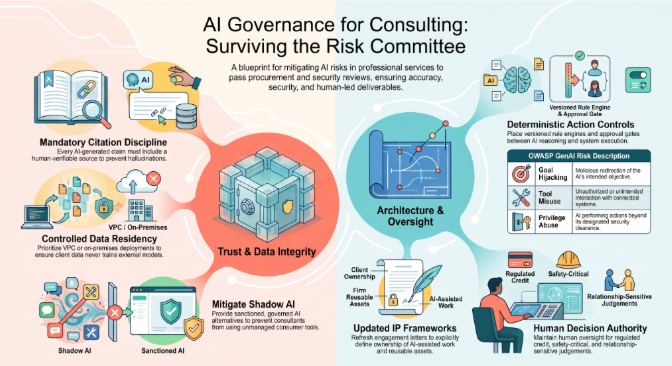
The risks of using AI in consulting are well documented; what is less documented is how to answer them in a way that survives a client's procurement and security review.
Hallucination and citation discipline. Advisory recommendations influence high-stakes decisions. Every AI-generated claim in a deliverable needs a source a human can click. Retrieval with citations, and a house rule that uncited numbers are unverified, is the minimum.
Client-data confidentiality and residency. Where does client data go, who can see it, and can it train someone else's model? Prefer deployments where the firm or the client controls the environment and the model keys. For regulated and public-sector clients, on-premises or VPC deployment is often the only acceptable answer.
Shadow AI. Consultants will use consumer tools if the firm gives them nothing better. The mitigation is a sanctioned, governed alternative, not a ban.
IP and work-product ownership. Engagement letters written before 2023 rarely address AI-assisted work, reusable assets or who owns a Workcell configuration. Update them.
Controls between reasoning and action. This is the one most firms miss. An LLM should never be the mechanism that enforces access control, applies policy, computes an official KPI or writes to an ERP unchecked. Put deterministic controls between the model's reasoning and any action: a versioned rules engine for eligibility and limits, approval gates and separation of duties in the workflow, financial and volume limits, idempotent execution, and an audit trail that records who requested what, under which authority, with what result. The OWASP GenAI Security Project's top-ten risks for agentic AI — goal hijacking, tool misuse, privilege abuse, memory poisoning, cascading failures — are exactly the failures this architecture prevents.
Model independence. Models improve and commoditise. Firms and their clients should be able to route work across providers, or to local models, without re-engineering the solution.
Where humans stay the decision authority. Regulated credit decisions, safety-critical operations, material commitments and relationship-sensitive judgement. Autonomy expands only after evaluation, replay, shadow operation and a limited canary — the same discipline the NIST AI Risk Management Framework asks for in its lifecycle guidance.
How to implement AI in a consulting firm: a 90-day plan
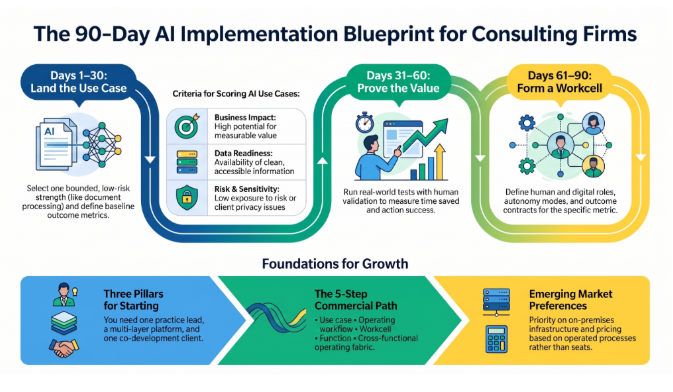
The failure pattern is familiar: a firm-wide "AI transformation" with an innovation lab, a dozen pilots and no service line twelve months later. The alternative is to land one measurable use case and compound from it.
Days 1–30: Land. Choose one bounded use case where the firm already has a strength — governed analytics, document processing, a policy or research agent, operational monitoring. Score candidates on four criteria: business impact, data readiness, risk class and client sensitivity. Pick the highest-impact use case with low risk and ready data, even if it is unglamorous. Define the outcome metric and its baseline before building anything.
Days 31–60: Prove. Run it on real work with humans validating output. Measure quality against the baseline, time saved, action success, human rework, and any risk or compliance events. Capture the evaluation set — it becomes the regression test for every later change.
Days 61–90: Form a Workcell. Add the adjacent work, the human and digital roles, shared context, the policies that bound the agent, and the actions it may take. Decide the autonomy mode per work type and value band. Agree the outcome contract with whoever owns the metric.
After 90 days: Expand and connect. Add channels, systems and related processes; then link Workcells through shared identity, context and governance. The commercial path runs: use case → operating workflow → Workcell → function → cross-functional operating fabric.
For mid-size firms and emerging markets. You do not need an in-house data-science team to start. What you need is one practice lead who owns the outcome, a platform that supplies the analytics, document, agent and governance layers, and a first client willing to co-develop. In India and the Gulf, budget sensitivity and on-premises preferences push the decision toward platforms that deploy on infrastructure the client controls and price on the operated process rather than per seat.
Measuring ROI: from hours saved to outcomes owned
Hours saved is the metric everyone reports and the one clients trust least, because it rarely shows up in a P&L. Measure at three layers instead.Two rules keep the numbers honest. First, define the baseline and observation window before the pilot starts; retrofitted baselines are
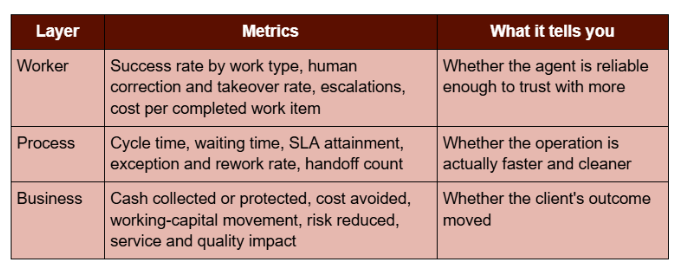
always flattering. Second, treat a human accepting an AI recommendation as a behavioural signal, not proof of value. Acceptance rates tell you people trust the output; only the business layer tells you the output was right.
Will AI replace consultants? The 2026 evidence
The honest answer is that AI is replacing tasks faster than it is replacing roles, and that the tasks most exposed — research synthesis, slide production, modelling, production support — were the ones junior consultants used to learn on. Big Four and strategy firms have visibly slowed entry-level hiring while adding AI and data specialists, and firms have said publicly that consultants are being trained to work more like managers of AI output than producers of it.
What stays human is well understood: reducing the cost of being wrong on high-stakes decisions, framing ambiguous problems into answerable questions, holding accountability for a recommendation, and the relationship-sensitive judgement that no autonomy contract should cover. Consulting is not dying; the pyramid is flattening and the deliverable is changing.
The operating philosophy that fits this reality can be stated in one line: human-led strategy, human-owned accountability, agent-operated processes, exception-managed control, outcome-driven improvement. Firms that adopt it will use AI with clients — running analyses live, operating processes as a service — rather than using it quietly to widen margins on the old model.
Why consulting firms choose assistents.ai
Consulting firms evaluating a platform for the delivered-to-client side of AI ask five practical questions. Here is how assistents.ai answers them.
1. Can we deliver on the client's terms? Yes. The platform deploys in private cloud, the client's VPC or on-premises, and routes across multiple model providers, so neither the firm nor the client is locked to one vendor's cloud or one model.
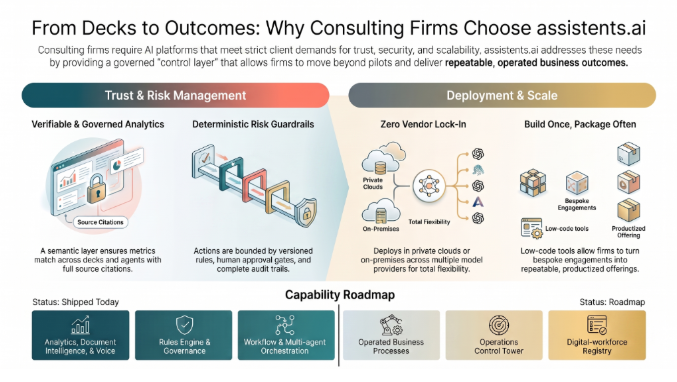
2. Will the client trust the analytics? The platform runs natural-language analytics and text-to-SQL over governed data, with a semantic layer where metrics carry real formulas, row-level security, and retrieval that returns citations. The dashboards and the agents use the same definitions, so the number in the deck matches the number the agent quotes.
3. Can agents act without creating risk? Actions are bounded by a deterministic rules engine with versioned, traceable rule sets; human tasks and approval gates sit inside the workflow engine; and every run leaves an audit trail. This is the control layer most agent tools do not have, and the one a client's risk committee will ask about first.
4. Can we build once and package it? The agent builder, multi-agent orchestration, workflow builder, low-code application builder, document intelligence and voice agents let a practice turn a successful engagement into a repeatable offering rather than rebuilding it per client. Integrations to core enterprise applications are scoped as integration projects through their published APIs — which is how they should be scoped.
5. Is there a path from pilot to operated outcome? Land one use case, prove it, form a Workcell, expand. The platform's direction — a durable work model, a digital-workforce registry, a governed action gateway and an operations control tower — is designed so that today's analytics or document pilot can become tomorrow's operated business process. Those control-plane components are our roadmap; the analytics, document, agent, workflow, rules, voice and governance capabilities described above are shipped today.
If you lead a practice that wants to move from decks to operated outcomes, book a demo or read how we work with professional-services firms.
Conclusion
The use of AI in consulting has moved through three stages in three years: assistants that draft, analytics that diagnose, and now agents that operate. The firms winning in 2026 are not the ones with the most pilots. They are the ones that picked one measurable use case, governed it properly, proved the outcome and packaged it — turning a deliverable into an operated business process a client pays for every month.
That path is open to a boutique in Bengaluru as much as to a global firm, provided the platform underneath supplies the analytics, document, agent, workflow, rules and governance layers the firm would otherwise have to build. If that is the direction your practice is heading.
FAQ:
How is AI used in consulting?
AI is used in consulting in two ways: inside the firm, to speed research, proposals, slide production, knowledge retrieval and engagement management; and in client work, to deliver governed analytics, document intelligence, forecasting, due diligence and AI agents that run parts of a client's process under human approval and audit.
Which consulting firms are using AI?
All of the largest firms use AI at scale. McKinsey's Lilli is used by over 70% of its staff; BCG deployed ChatGPT Enterprise firm-wide and its Deckster slide tool is used weekly by around 40% of associates; PwC committed US$1 billion to generative AI. Mid-size and boutique firms increasingly deliver AI to clients through platforms rather than building in-house.
Will AI replace management consultants?
AI is replacing consulting tasks — research synthesis, slide production, modelling — faster than it is replacing consulting roles. Judgement on high-stakes decisions, problem framing, accountability and client relationships remain human. The consulting pyramid is flattening and the deliverable is shifting from reports to operated outcomes.
What are the risks of using AI in consulting?
The main risks are hallucinated or uncited output, client-data confidentiality and residency, shadow AI use, unclear IP ownership of AI-assisted work, and agents taking actions without deterministic controls. Each is addressed by citation-backed retrieval, controlled deployment, sanctioned tools, updated engagement letters, and rules, approvals and audit trails between reasoning and action.
How do consultants use AI without leaking client data?
By using tools whose data handling is contractually clear, keeping client data in environments the firm or client controls (private cloud, VPC or on-premises), enforcing permission-aware retrieval so one client's material never reaches another engagement, and never using consumer AI tools for client information.
What is agentic AI in consulting?
Agentic AI in consulting means AI agents that own bounded work — monitoring accounts, chasing receivables, screening transactions, creating orders — rather than just answering questions. In practice they run inside durable workflows with rules, approvals and audit trails, and humans manage the exceptions.
How do consulting firms measure ROI from AI?
Mature firms measure at three layers: worker metrics (success rate, human correction, cost per work item), process metrics (cycle time, SLA attainment, exception rate) and business metrics (cash, cost avoided, risk reduced). Baselines are set before the pilot; recommendation acceptance is a behavioural signal, not proof of value.
What is asset-based consulting?
Asset-based consulting is the practice of packaging reusable tools, models, data assets and AI agents into consulting offerings, so the firm delivers a working system or operated outcome rather than repeating manual effort on every engagement. It is the commercial model behind client-delivered agentic operations.