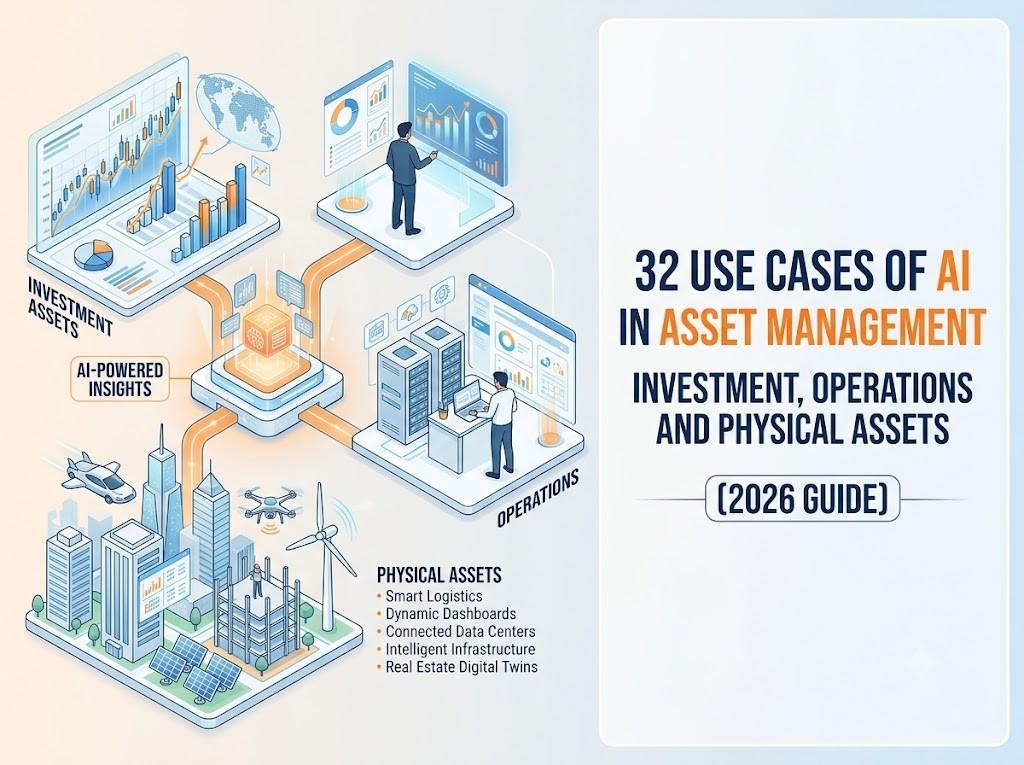
The use cases of AI in asset management fall into two families that search engines, and most blogs, blur together: AI for firms that manage financial assets (portfolios, funds, client money) and AI for organisations that manage physical and enterprise assets (grids, plants, fleets, buildings, equipment). This guide covers both. It lists 32 use cases, tells you what data each one needs, which level of autonomy it can safely run at, what controls it requires, and which metric it moves. Where we have production evidence, we say so, anonymised.
The 2026 shift is not better chat. It is agents that observe, decide and act inside a governed boundary while humans own accountability. Every use case below is written with that in mind.
Which asset management do you mean?
"AI asset management" means different things to a portfolio manager and a plant maintenance lead. The technology overlaps; the data, controls and metrics do not.
This article focuses on the first two. IT and digital asset management deserve their own treatment and are out of scope here.
The state of AI in asset management in 2026
Three findings frame every use case that follows.
Adoption has moved past experimentation. Mercer's May 2026 study finds the industry has moved beyond experimenting with AI, with 73% of firms using it for operational efficiency and 68% using it as a partner in the investment process, principally as an augmentation tool (Mercer, 2026). Microsoft cites EY research in which 95% of wealth and asset managers reported scaling generative AI across multiple use cases and 78% were exploring agentic AI (Microsoft Cloud Blog, June 2026).
The economics are being restructured, function by function. BCG's 2026 Global Asset Management Report describes agentic systems automating execution at 70–80%, reducing operational costs by around 40%, and freeing 35–50% of distribution capacity, with the competitive edge moving to what firms do with insight, client trust and customisation that was previously uneconomical (BCG, June 2026).
The operating model is the constraint, not the model. The head of innovation at one large UK asset manager describes the firm's progression from human-prompted tasks to systems that act proactively, first with human approval for each action and over time autonomously within human-defined policies and controls (Portfolio Adviser, May 2026). That is the autonomy ladder stated by a buyer, and it is the lens we use throughout.
The autonomy ladder used in this guide
Different decisions inside one process sit at different rungs. A reminder email can be executed automatically; a fee waiver cannot. Every use case below carries a recommended starting rung, not a ceiling.
Part A: 20 use cases of AI in investment and financial asset management
Organised by front, middle and back office, because that is how asset managers budget, staff and govern.
Front office: research and portfolio management
1. Research synthesis and triage. Agents read the hundreds of broker notes, filings and transcripts that arrive daily, rank them by relevance to current holdings and watchlists, and produce an evidence-linked brief for each analyst. Data: research feeds, holdings, prior notes. Autonomy: Assist to Recommend. Controls: source citations on every claim, no unsourced numbers. Metric: analyst hours per name covered, coverage breadth.
2. Market-regime and allocation support. Models compare current cross-asset conditions with historical regimes and flag when allocation assumptions no longer hold. Data: market and macro series, portfolio constraints. Autonomy: Recommend. Controls: model version pinned per recommendation, committee sign-off. Metric: time from regime shift to allocation review.
3. Sentiment and event monitoring. Watcher agents scan news, filings and social sources for events affecting holdings, deduplicate signals, and attach confidence and severity before creating work. Data: news, filings, holdings map. Autonomy: Coordinate. Controls: signal thresholds, deduplication keys, no auto-trading. Metric: time-to-awareness on material events.
4. Signal generation with strategy simulation. Agents ingest market data, run indicator and pattern analysis, simulate candidate strategies against risk guardrails and produce execution-ready summaries for a human desk. Data: market data, strategy library, risk limits. Autonomy: Recommend, with Execute only below defined thresholds. Controls: hard risk limits in a deterministic rule engine, shadow mode before live. Metric: strategy evaluation cycle time, guardrail breaches (target: zero).
Production evidence: an AI-first trading terminal deployed a network of specialised agents for market-data ingestion, indicator analysis, strategy simulation and alerting under risk guardrails, with faster synthesis of fragmented market signals and reduced manual monitoring effort.
5. Portfolio risk and early-warning monitoring. Continuous monitoring of concentration, liquidity, delinquency and covenant metrics, with investigation of the cause before a human is alerted. Data: positions, exposures, counterparties, external risk feeds. Autonomy: Coordinate. Controls: certified metric definitions, escalation matrix by severity. Metric: exceptions caught before breach.
Production evidence: an automotive leasing provider deployed portfolio KPI analytics covering risk, delinquency, maturity and residuals, plus dealer-network performance and early-risk alerts, reporting better portfolio visibility and faster risk identification.
6. ESG and issuer-document extraction. Agents extract targets, disclosures and deviations from lengthy sustainability reports and issuer documents so analysts engage on substance rather than page-turning. Data: issuer PDFs, ESG frameworks. Autonomy: Assist. Controls: extraction confidence scores, human review on low-confidence fields. Metric: documents processed per analyst-day.
Distribution and client servicing
7. Client-servicing agents (chat, email, voice). Permissioned agents answer statement, holding and process questions across channels, escalate anything advisory, and log every interaction. Data: client records, statements, FAQs, policies. Autonomy: Execute for informational requests, Recommend for anything else. Controls: row-level permissions, advisory-content prohibition, full transcript audit. Metric: first-response time, containment rate, complaint rate.
8. RFP and DDQ drafting. Agents assemble draft responses from prior filings, approved answer libraries and fund documents, flag version conflicts across vintages and route to compliance. BCG notes that relationship managers currently lose significant time to RFPs, due diligence questionnaires and servicing workflows (BCG, 2026). Autonomy: Assist to Recommend. Controls: approved-answer library as the only source, compliance sign-off. Metric: DDQ turnaround time.
9. Personalised reporting and commentary. Generation of client-specific performance commentary from certified metrics, with human review before distribution. Data: performance data, mandate terms, house views. Autonomy: Assist. Controls: numbers pulled from the semantic layer only, never generated. Metric: reporting cycle days.
10. Next-best-action for relationship managers. Always-on account monitoring surfaces renewal risk, cross-sell opportunity and service gaps, then orchestrates follow-up under governed playbooks. Data: CRM, interaction history, product holdings. Autonomy: Coordinate. Controls: rule-governed opportunity criteria, human ownership of every outreach. Metric: account coverage per RM, response cycle on renewals.
Production evidence: an engineering and technology group deployed an agentic sales agent for account monitoring, rule-governed opportunity identification and follow-up orchestration, reporting higher account coverage without increasing headcount and more consistent execution via governed playbooks.
11. Onboarding and KYC document validation. Document intelligence extracts, validates and reconciles identity and mandate documents, with human review for exceptions. Data: onboarding packs, sanctions lists, mandate templates. Autonomy: Coordinate. Controls: maker-checker, exception queue, immutable audit. Metric: onboarding cycle time, rework rate.
Middle office: risk, compliance and diligence
12. Regulatory and cross-border pre-screening. Transactions are screened early for withholding tax, VAT mismatches and permanent-establishment risk, with explainability notes and escalation to specialists. Data: transaction details, jurisdiction rules, entity structures. Autonomy: Recommend. Controls: rules encoded deterministically, human sign-off on classifications. Metric: risks detected pre-deal, last-minute deal disruptions.
Production evidence: a tax-technology product deployed transaction-screening workflows with risk classification, evidence collection and expert escalation, reporting earlier detection of withholding and VAT risk and fewer last-minute deal disruptions.
13. Disputes, fraud and compliance case handling. Omnichannel intake, workflow routing, agent-assist summaries and next-best actions, with auditable case history. Data: case records, transaction logs, policy documents. Autonomy: Coordinate. Controls: SLA monitoring, separation of duties, audit trail per case. Metric: case cycle time, consistency of outcomes.
Production evidence: a fintech provider serving banks and credit unions deployed omnichannel AI agents with auditable workflow automation for disputes and support, reporting faster case handling, reduced operational load and better compliance readiness via audit trails.
14. Deal and technology due diligence. Structured assessment of a target's architecture, scalability and security, producing a risk register and remediation roadmap. Data: code, infrastructure documentation, vendor questionnaires. Autonomy: Assist. Controls: human expert validation of every finding. Metric: diligence cycle time, post-deal surprises.
Production evidence: a long-term holding company used technical due diligence on a mobile-banking platform covering architecture, scalability and security, reporting faster investment decisions and reduced post-deal surprises via remediation planning.
15. Model and policy explanation for regulators. Every AI-assisted decision carries a record of inputs, rules applied, alternatives considered and the human response, retrievable on demand. Data: decision ledger. Autonomy: Assist. Controls: immutable versioning of prompts, rules and models. Metric: time to answer a regulatory query.
Back office: operations and finance
16. Reconciliation and NAV exception investigation. Agents match breaks across custodian, fund-admin and internal records, gather evidence and propose resolution; humans approve. Data: position and cash files, custodian feeds. Autonomy: Recommend, Execute for low-value matches. Controls: value thresholds, maker-checker. Metric: breaks aged over 24 hours.
17. Treasury and cashflow forecasting. Forecast and scenario agents connect to accounting and banking exports, project cash and runway, and alert on risks with recommended actions. Data: ledgers, bank feeds, receivables, payables. Autonomy: Recommend. Controls: forecast versioning, assumption logs. Metric: forecast error, days of early warning.
Production evidence: an AI-CFO platform deployed forecasting and scenario agents with runway-risk alerts and advisor portfolio views, reporting earlier detection of cash risks and scalable advisory-style insight without added headcount.
18. Receivables and fee follow-up. A receivables agent prioritises overdue accounts, sends approved reminders, captures promises to pay, monitors broken promises and escalates disputes or negative sentiment to an account manager. Data: invoices, contracts, correspondence. Autonomy: Execute for standard reminders, Recommend for negotiation, prohibited for waivers. Controls: contact-frequency limits, value caps, escalation triggers. Metric: cash collected, promise-kept rate, DSO.
19. Cross-entity KPI consolidation. Standardised metric definitions across entities, consolidated reporting and variance explanations, with data-quality checks as a governance layer. Data: multi-entity ERP and finance systems. Autonomy: Assist to Coordinate. Controls: single semantic layer, metric ownership. Metric: leadership reporting cycle, metric disputes.
Production evidence: a multinational logistics company deployed analytics consolidation across multi-entity global operations, reporting a single operational view across entities and faster leadership reporting.
20. Insight-to-action on existing dashboards. Rather than replacing BI, an agent layer converts dashboard insights into governed tasks, assigns owners, tracks completion and reports what changed. Data: existing BI, task systems. Autonomy: Coordinate. Controls: rules, hierarchies and formulas in a semantic governance layer. Metric: insight-to-action time, task completion rate.
Production evidence: a retail holding group deployed an agentic analysis layer with a unified context engine over structured and unstructured data, reporting a shift from reactive reporting to proactive execution loops and standardised decision logic across teams.
Why assistents.ai is the strongest option for these use cases
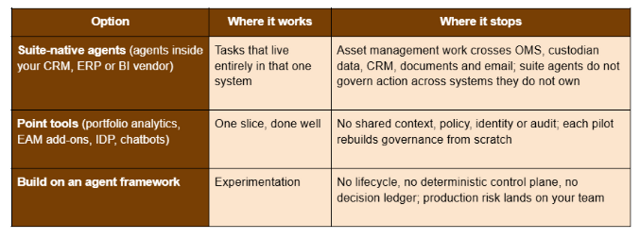
Most tools in this market solve one slice: a portfolio analytics product, an intelligent document platform, a chatbot, a workflow engine. The use cases above cut across all of them, which is why point tools stall at the pilot. assistents.ai is a governed enterprise AI operations platform that sits above the systems you already run and converts data, documents, policies, rules and workflows into contextual intelligence, governed decisions, coordinated actions and measurable outcomes.
Two things distinguish the platform from agent frameworks and suite add-ons. First, reasoning plus deterministic control: the LLM interprets ambiguity; rules, permissions and workflows enforce the boundary. Second, answers plus action: the same platform that explains a receivables backlog can send the approved reminder, log the promise and escalate the dispute, with every step recorded. Your ERP, OMS and CRM remain authoritative.
Part B: 12 use cases of AI in enterprise and physical asset management
For utilities, infrastructure operators, manufacturers, real estate owners and asset-heavy groups, AI asset management is about uptime, lifecycle cost, energy and capital works.
Asset performance and maintenance
21. Predictive maintenance indicators. Sensor, SCADA and work-order histories feed models that estimate remaining useful life and generate maintenance work orders based on condition rather than calendar. Data: telemetry, maintenance logs, failure records. Autonomy: Recommend, moving to Coordinate for work-order creation. Controls: engineering sign-off on any change to maintenance strategy. Metric: unplanned downtime, emergency repairs.
22. Transmission and distribution anomaly detection. Continuous monitoring of grid KPIs, loss and outage analytics, and automated alerts routed to field operations. Data: SCADA, metering, outage records. Autonomy: Coordinate. Controls: alert thresholds owned by operations, human dispatch. Metric: time to detect exceptions, losses.
Production evidence: a state power-transmission utility deployed transmission KPI monitoring with anomaly detection, loss and outage analytics, predictive-maintenance indicators and automated field alerts, reporting faster identification of grid exceptions and improved reliability through proactive monitoring.
23. Smart-grid predictive analytics at city scale. Predictive analytics for outages, losses and field issues over smart utility systems, with alert routing for resolution. Data: smart-meter and grid telemetry, asset registers. Autonomy: Coordinate. Controls: severity-based routing, no autonomous switching actions. Metric: exception response coordination time.
Production evidence: a city-scale smart-infrastructure operator deployed agentic analytics and automated operational alerting over smart utility systems, reporting higher operational visibility and more proactive grid operations via continuous monitoring.
24. Asset lifecycle and repair-versus-replace analysis. Total cost of ownership across purchase, maintenance, energy and disposal, with recommendations on the optimal point to repair, refurbish or replace. Data: asset register, cost history, failure rates. Autonomy: Recommend. Controls: capital-approval thresholds. Metric: lifecycle cost per asset class.
25. Critical-spares monitoring and stock transfer. Watcher agents track critical-spare levels against campaign and maintenance schedules, propose transfers or expedites, and create transactions after approval. Data: inventory, maintenance plans, supplier lead times. Autonomy: Coordinate, Execute for transfers below a value threshold. Controls: maker-checker on ERP writes, source-site risk check. Metric: stockouts of critical spares, expedite cost.
Energy and sustainability
26. Campus and facility energy management. Ingestion of utility and sensor data, anomaly detection on consumption, forecasting and optimisation recommendations with proactive alerts. Data: meter data, building systems, occupancy, weather. Autonomy: Recommend. Controls: setpoint changes require facilities approval. Metric: energy consumption, inefficiencies detected.
Production evidence: a research institute deployed energy-management AI covering sensor ingestion, anomaly detection, forecasting and optimisation for campus consumption, reporting improved energy visibility and faster detection of inefficiencies.
27. ESG and consumption reporting. Automated assembly of energy, emissions and waste metrics from operational data into audit-ready reports. Data: meter data, procurement, fleet records. Autonomy: Assist. Controls: metric definitions certified once, reused everywhere. Metric: reporting effort, restatements.
Capital works and procurement
28. Tender and capital-project document intelligence. Multi-agent orchestration retrieves tenders, determines the workflow, extracts scope from complex PDFs, detects revisions and synchronises data into operational systems with audit logs. Data: tender documents, revision history, job-management system. Autonomy: Coordinate. Controls: quote locking, full CRUD audit, human review on extraction confidence. Metric: tender processing time, bid risk from missed revisions.
Production evidence: a remedial building-works specialist deployed an intelligent document workbench for tender retrieval, vision-LLM extraction and revision analysis with deep integration into its job-management system, engineered for up to ~90% faster tender document processing and a ~95% extraction-accuracy target on standard formats.
29. RFQ automation and supplier follow-up. Agents generate RFQs, match suppliers, chase responses, extract and compare quotations and support the sourcing decision. Data: item masters, supplier records, quotations. Autonomy: Coordinate. Controls: approved-supplier policy, conflict-of-interest checks, value thresholds. Metric: procurement cycle time, price and lead-time competitiveness.
Production evidence: a pharma sourcing platform deployed RFQ automation and supplier-matching workflows with price and lead-time analytics, reporting faster procurement cycles and reduced vendor coordination effort.
30. Vendor-performance and margin KPI alerts. Group-wide standardisation of procurement and finance KPIs with automated alerts on purchase-price trends, gross-margin impact, early-payment economics and vendor delivery or return performance. Data: purchasing, AP, receiving, returns. Autonomy: Coordinate. Controls: single KPI definition set, alert ownership. Metric: margin erosion detected early, vendor slippage.
Production evidence: a diversified family business group deployed automated procurement and finance KPI alerts across entities, reporting earlier detection of margin erosion and vendor slippage and fewer variance surprises.
Infrastructure operations
31. Terminal and rail exception management. Digitised terminal workflows, yard and rail visibility, scheduling and exception management with executive dashboards and operational alerts. Data: terminal operating system, rail schedules, gate events. Autonomy: Coordinate. Controls: human dispatch authority preserved. Metric: terminal-to-rail throughput predictability.
Production evidence: a global ports and logistics operator deployed a terminal and rail management solution with exception management, reporting higher predictability of terminal-to-rail throughput and more efficient coordination across terminal and inland logistics.
32. Property and tenant service agents. Omnichannel agents triage tenant queries, handle rental and payment support workflows, escalate to human teams and draw on a knowledge base of policies and tenancy documents. Data: tenancy records, policies, ticketing. Autonomy: Execute for FAQs and status, Coordinate for everything else. Controls: escalation rules, SLA tracking. Metric: response time, call-centre load, SLA adherence. For the wider property picture, see our guide to AI use cases in real estate.
Production evidence: a large real-estate portfolio owner deployed a customer-service agent for tenant support with ticketing and escalation, reporting faster response times, lower call-centre load and a consistent 24×7 tenant experience.
How to sequence AI in asset management
The firms that get value do not switch on autonomy. They earn it, one decision class at a time.
Step 1: land with one measurable operation. Governed analytics, document processing, a monitoring agent or a servicing agent. Pick a process with a trigger, a completion state, a named owner and a baseline number: exceptions per month, DSO, unplanned downtime, tender turnaround.
Step 2: prove quality before authority. Measure evidence quality, human rework, action success, risk events and business impact. Human acceptance of a recommendation is a behavioural signal, not proof of value; the metric that moves is.
Step 3: widen the envelope by segment and value, not globally. A receivables agent can run standard reminders for SME accounts under a balance cap while disputes stay in co-work mode and waivers remain prohibited. An illustrative authority envelope looks like this:
agent: receivables-agent
work_type: standard_overdue_followup
scope: { segment: SME, overdue_days: 1-30 }
permitted: [read_account, send_approved_reminder, create_followup_task, record_promise_to_pay]
prohibited: [negotiate_payment_plan, waive_charge]
limits: { balance_max: 1000000, contacts_per_customer_per_week: 3 }
escalate_when: [dispute_detected, negative_sentiment, legal_threat, confidence_below_0.80]
\
The same pattern applies to a maintenance agent (create work orders below a cost threshold; never change a maintenance strategy) or a trading agent (simulate freely; execute only inside hard risk limits).
Step 4: connect operations. Once receivables, reconciliation and client servicing share the same context, rules, identity and audit, the second use case costs a fraction of the first. That is the difference between a collection of pilots and an operating layer.
The deployment discipline that makes this safe: every material change to an agent, model, rule or autonomy setting moves through draft, offline evaluation, replay on historical cases, shadow mode, human-approved execution, limited canary and monitored rollout, with rollback triggers defined in advance.
Governance, risk and regulation
Asset management is a fiduciary business and, on the physical side, often a safety-critical one. Governance is part of the operating design, not a module added later.
Deterministic controls sit between reasoning and action. The LLM proposes; a rule engine evaluates policy; permissions and approvals decide; the action executes with an idempotency key and is verified afterwards. No agent should hold shared system credentials or an ungoverned write path.
Separation of duties and approval policies apply per decision class: recommend only; require human approval; act automatically below a defined threshold; act and notify; act within a tightly defined policy boundary; prohibit automated action. Different decisions in the same process carry different modes.
Auditability and explainability. Every decision carries its inputs, the policy version applied, the alternatives considered and the human response. Regulators increasingly expect firms to explain AI-assisted decisions; a decision ledger answers that in minutes rather than weeks.
Data residency and deployment. Regulated firms and critical-infrastructure operators frequently require private cloud, customer VPC or on-premise deployment with customer-controlled model access. Treat this as a design requirement, not a procurement afterthought.
Frameworks to align with. The NIST AI Risk Management Framework and its Generative AI Profile for lifecycle governance; the OWASP agentic-security guidance for risks such as goal hijacking, tool misuse, privilege abuse and memory poisoning; and, for physical assets, existing engineering authority and safety-case processes, which AI must not bypass.
Will AI replace asset managers? No. Across the evidence above, AI is removing repetitive investigation, drafting and monitoring work so people focus on judgement, client relationships, policy and exceptions. Accountability stays human. The firms that benefit are the ones that redesign roles around that division of labour.
Why assistents.ai over the alternatives
Buyers evaluating AI for asset management usually face three alternatives.
assistents.ai is built for the fourth option: a governed layer above the systems you already run, with one semantic context, one rule engine, one approval and audit fabric, and agents, workflows, documents, analytics and voice all operating inside it. It is model-neutral, so investment teams can use the models their risk function approves, and it supports customer-controlled deployment for firms that cannot move data to a vendor cloud. The first implementation creates reusable capabilities; the next use case is faster and cheaper because the governance already exists.
Systems of record store the enterprise. Systems of intelligence explain the enterprise. assistents.ai is the System of Agency that helps humans and AI agents operate the enterprise together.
See how it compares: assistents.ai vs Salesforce Agentforce · vs UiPath · vs Glean · all comparisons.
Conclusion
The question "what are the use cases of AI in asset management" has 32 answers here, but one test underneath them. For any candidate use case, ask: which asset class, which office or operation, which autonomy level, which controls, and which metric. If you can answer all five, the use case is ready to pilot. If you cannot, it is a demo.
Technology is no longer the bottleneck. The operating model is: how work is represented, who or what performs it, what context and authority it carries, and whether the outcome was achieved. That is what a governed platform provides and what a collection of point tools cannot.
FAQs
What is AI asset management?
AI asset management is the use of machine learning, natural-language processing and AI agents to monitor, analyse, decide and act on assets. In investment management it covers research, portfolio risk, client servicing, compliance and operations. In enterprise asset management it covers predictive maintenance, anomaly detection, lifecycle planning, energy and capital works.
How do asset managers use AI in 2026?
Primarily for operational efficiency and as a partner in the investment process, according to Mercer's 2026 study. Common uses include research synthesis, risk monitoring, RFP and DDQ drafting, client servicing, reconciliation and compliance case handling, increasingly performed by agents that act under human approval.
What are examples of AI in asset management?
Portfolio-risk and delinquency monitoring for a leasing book; omnichannel dispute handling for banks; cashflow forecasting agents; cross-border tax pre-screening; transmission-grid anomaly detection; campus energy optimisation; tender document intelligence; tenant service agents. Each is described above with its data, controls and metric.
What is agentic AI in asset management?
Agentic AI systems observe conditions, gather evidence, decide and take bounded actions across workflows under human guidance, rather than only generating text. In asset management this means agents that reconcile breaks, draft DDQs, chase receivables or create maintenance work orders inside defined authority limits.
Will AI replace asset managers?
No. The evidence points to augmentation: AI removes repetitive investigation, drafting and monitoring work while humans retain judgement, client relationships, fiduciary accountability and exception handling.
What is the difference between AI in asset management and AI in wealth management?
Asset management concerns institutional portfolios, funds and mandates; wealth management concerns individual clients and advice. AI use cases overlap in research and servicing, but wealth management adds suitability, personalisation and advice-regulation constraints.
What are the risks of AI in asset management?
Ungoverned actions, hallucinated numbers, model drift, data leakage, prompt injection and unclear accountability. Mitigations include deterministic rules between reasoning and action, certified metric layers, approval policies per decision class, immutable audit and shadow-mode evaluation before autonomy expands.
How much does AI reduce costs in asset management?
BCG's 2026 report describes operational costs falling by around 40% and execution automating at 70–80% where agentic systems are deployed at scale. Results vary by function and starting point; treat published figures as directional and measure against your own baseline.
How do you start with AI in asset management?
Choose one recurring, cross-system process with a named owner and a baseline metric. Deploy at Assist or Recommend level, measure quality and rework, then expand authority by segment and value threshold as evidence accumulates.